Ten tips for keeping your heart healthy

Coronary heart disease is the biggest killer causing many deaths each year. More than a quarter of the deaths occur in people who are younger than 75 and experts say the majority are preventable.

1. Buy a blender

The World Health Organization recommends eating a minimum of 400g of fruit and veg a day to lower the risk of serious health problems, such as heart disease. Easier said than done? By throwing some fruit in the blender and starting the day with a tasty juice or smoothie, you’ll have hit your five a day target before you’ve even left for work. And with so many great combinations to try (butternut squash, ginger and date anyone?), you’ll soon be hooked.

2. Say no to tobacco

Smoking is one of the main causes of coronary heart disease. According to the NHS, a year after giving up, your risk of a heart attack falls to about half that of a smoker. And your bank balance won’t look so bad either! Ditching the ciggies can be tricky so speak to your doctor.

3. Ditch the bus for the bike

To keep the heart healthy, it is recommended that adults aged 19-64 fit in 150 minutes of moderate aerobic activity a week. It sounds like a lot but broken down that’s 30 minutes of activity on five days of the week. If you can, running, cycling or walking to work is a great way to squeeze it in without taking time out of your day. You’ll impress your colleagues too.

4. Walk the dog

Taking the dog out for a walk is another brilliant way to get fresh air and daily exercise. Don’t have a pooch? Why not borrow a friend or neighbour’s furry friend? You’ll be doing them a favour, and you get some company while you exercise. Just don’t expect great conversation.

5. Fish Fridays

Cold water fish such as mackerel, sardines, tuna and salmon are a rich source of omega-3 fats, which can help protect against heart disease. Try swapping meat out for fish a few days of the week. Cod luck!

6. Go nuts

Walnuts, almonds, peanuts, and other nuts are packed with mono-unsaturated, heart-friendly fats, and studies show they help to lower the bad form of cholesterol. Grab a handful instead of crisps or chocolate when you feel peckish, and sprinkle them on top of salads or cereal for a tasty crunch.

No pressure, but Barry needs walkies.

7. Swap the cocktails for the mocktails

Drinking excessive amounts of alcohol causes raised blood pressure – one of the biggest risk factors for having a heart attack. All those calories can also mean weight gain, another factor in heart disease. Try cutting down on the booze if you can, avoid binging, and squeeze in a few ‘dry’ days every week. There are some great alcohol free wines on the market plus some ‘mocktails’ taste as good as the real deal. Another fun way to hit your five a day!

8. Take a deep breath

Stress is another big factor in high blood pressure so try to stay calm and stress free as much as possible. Deep, slow breathing is the simplest technique for decreasing stress and therefore one of the most effective natural remedies for high blood pressure. You can do it wherever you are and whatever you’re doing – and it’s free!

9. Go Karaoke crazy

Researchers at the University of Gothenburg, Sweden, found that choristers’ heartbeats synchronised when they sang together, bringing about a calming affect that could mean resilience to cardiac arrest. Dr Björn Vickhoff, who led the study says, “Song is a form of regular, controlled breathing… It helps you relax, and there are indications that it does provide a heart benefit.” Don’t fancy joining a choir? Then go wild with some guilt free singing in the shower.

10. Aim for eight hours between the sheets

Irregular or insufficient sleep – less than six hours a night – appears to be hazardous to our heart health, increasing the risk of stroke or heart attack. Sleep-deprived people have higher blood levels of stress hormones, a key player in cardiovascular disease, and lack of sleep can also alter your metabolism, making you prone to weight gain. If you can, keep your bedroom nice and quiet, try not to eat a big meal too late at night (which can ramp up your metabolism and make it difficult for your body to wind down), and avoid caffeine late in the day.

Source: BBC Broadcasting House, Portland Place, London

Thanksgiving

🌽 🎃 🦃 Thanksgiving Day é um feriado nacional comemorado no Canadá, Estados Unidos, algumas das ilhas do Caribe e Liberia.

Começou como um dia de dar graças pela benção da colheita e do ano anterior.

O Dia de Ação de Graças é comemorado na segunda segunda-feira de outubro no Canadá e na quarta quinta-feira de novembro nos Estados Unidos, e em torno da mesma parte do ano em outros lugares.

Embora o Dia de Ação de Graças tenha raízes históricas nas tradições religiosas e culturais, tem sido celebrado durante muito tempo como um feriado secular.

Abaixo, segue o cardápio tradicional do jantar.

A História do Halloween 🎃

História do Halloween

Halloween cai em 31 de outubro de cada ano na América do Norte e em outras partes do mundo. O que você sabe sobre Halloween? Você celebra isso em seu país? Aqui está um pouco de história sobre isso.

Como muitos outros feriados, Halloween evoluiu e mudou ao longo da história. Há mais de 2.000 anos, as pessoas chamadas celtas viviam no que é agora a Irlanda, o Reino Unido e partes do norte da França. 1 de novembro foi seu dia de ano novo. Eles acreditavam que a noite anterior ao Ano Novo (31 de outubro) era uma época em que os vivos e os mortos se juntaram.

Há mais de mil anos, a igreja cristã recebeu o primeiro dia de todos os santos (também chamado de All Hallows). Este foi um dia santo especial para honrar os santos e outras pessoas que morreram por sua religião. Na noite anterior, All Hallows foi chamado Hallows Eve. Mais tarde, o nome foi alterado para Halloween.

Como os celtas, os europeus da época também acreditavam que os espíritos dos mortos visitariam a Terra no Dia das Bruxas. Eles estavam preocupados com o fato de espíritos malignos causar problemas ou machucá-los. Então naquela noite as pessoas usavam figurinos que pareciam fantasmas ou outras criaturas malignas. Eles pensavam que se eles se vestiam assim, os espíritos pensariam que também estavam mortos e não os prejudicavam.

A tradição do Halloween foi levada para a América pelos europeus imigrantes. Entretanto, algumas das tradições mudaram um pouco. Por exemplo, no Halloween na Europa, algumas pessoas levariam lanternas feitas de nabos. Na América, as abóboras eram mais comuns. Então as pessoas começaram a colocar velas dentro deles e usá-las como lanternas. É por isso que você vê Jack ‘o lanterns hoje.

Hoje em dia Halloween não é geralmente considerado um feriado religioso. É principalmente um dia divertido para crianças. As crianças se vestiram de fantasias como as pessoas faziam mil anos atrás. Mas em vez de se preocuparem com espíritos malignos, eles vão de casa em casa. Eles tocam nas portas e dizem “doçura ou travessura”. O proprietário de cada casa dá doces ou algo especial para cada truque ou treater.

Feliz Dia das Bruxas!

Fonte: http://www.5minuteenglish.com/oct29.htm

History of Halloween

🎃

Halloween falls on October 31st each year in North America and other parts of the world. What do you know about Halloween? Do you celebrate it in your country? Here is a little history about it.

Vocabulary

to evolve (v)– to change little by little

spirit (n)– ghost, some people believe the spirit and body separate when a person dies

holy (adj)– sacred, very good, related to religion. Hallow comes from the word holy.

saint (n)– an honored, holy person

evil (adj)– very, very bad

lantern (n)– lamp or enclosed light that can be carried around

turnip (n)– a purple and white vegetable that grows in the ground

Like many other holidays, Halloween has evolved and changed throughout history. Over 2,000 years ago people called the Celts lived in what is now Ireland, the UK, and parts of Northern France. November 1 was their New Year’s Day. They believed that the night before the New Year (October 31) was a time when the living and the dead came together.

More than a thousand years ago the Christian church named November 1 All Saints Day (also called All Hallows.) This was a special holy day to honor the saints and other people who died for their religion. The night before All Hallows was called Hallows Eve. Later the name was changed to Halloween.

Like the Celts, the Europeans of that time also believed that the spirits of the dead would visit the earth on Halloween. They worried that evil spirits would cause problems or hurt them. So on that night people wore costumes that looked like ghosts or other evil creatures. They thought if they dressed like that, the spirits would think they were also dead and not harm them.

The tradition of Halloween was carried to America by the immigrating Europeans. Some of the traditions changed a little, though. For example, on Halloween in Europe some people would carry lanterns made from turnips. In America, pumpkins were more common. So people began putting candles inside them and using them as lanterns. That is why you see Jack ‘o lanterns today.

These days Halloween is not usually considered a religious holiday. It is primarily a fun day for children. Children dress up in costumes like people did a thousand years ago. But instead of worrying about evil spirits, they go from house to house. They knock on doors and say “trick or treat.” The owner of each house gives candy or something special to each trick or treater.

Happy Halloween!

Aprendendo Inglês na Terceira Idade

There are many benefits of studying for older learners, such as increased self-confidence, increased feelings of health and well-being, reduced feelings of isolation, and increased engagement in the community. 

Many seniors wish to study a foreign language and there is now substantial evidence that they can learn a new language effectively. My experience is that senior learners are excellent language students for a number of reasons.

Life experience

Senior students have a wealth of life experience and when they bring this to the classroom they enrich the learning experience of the whole class. Our teachers comment that older learners are excellent students to have in the classroom as they are always happy to talk about their experiences and give their opinions on a wide range of topics.

Great motivation

Senior learners do not normally need a certificate, diploma or university credit; their motivation is intrinsic. They may study for intellectual enjoyment, to socialise with their peers or because it is something they have always wanted to do. In fact, senior learners are very often more highly motivated than younger learners. Their high level of motivation is a great advantage as this has been identified as one of the most important factors in determining successful language learning. The motivation of senior learners is reflected by the fact that they rarely miss a class, participate very actively in the classroom and always do their homework.

Social element

We have discovered that there is a strong social component in seniors attending English classes. They often attend class to mix with their peers, forming very strong friendships and socialising together after the class and even in their free time.

Attitude

Our experience is that senior learners have an extremely positive attitude toward language learning and life in general. They treat both their teachers and their classmates with the utmost respect and politeness. Our teachers often comment on how kind, considerate, and hardworking senior learners are, and what a pleasure they are to teach.

So our experience is that the life experience, motivation to learn, and positive attitude of senior learners provide them with many advantages as language learners. However, there are cognitive, affective and physiological factors which can affect senior language learning. We are going to identify these factors and then look at how you can adapt your courses and practices to meet the needs of older learners.

Helping students hear

Hearing loss may have a direct impact on learning and performance for senior learners. In order to decrease the negative effects of this auditory loss, teachers should try to accommodate the aging ear in a number of ways by:

• speaking clearly and ensuring that the students can see their face and lips.

• adjusting the volume for listenings and videos.

• repeating listening texts.

• using short films and videos which aid listening comprehension as students can see the face and lips of the speakers.

• ensuring that your classrooms have little background noise.

Helping students see

Defective vision increases dramatically as people age. Visual ability is particularly important in education as it is generally accepted that approximately 80% of all learning occurs through vision. To accommodate this loss in vision, here are some steps to follow:

• Use a larger print type for printed text.

• Make sure that senior students sit as close to the board as possible.

• Write very clearly on the board.

• Ensure that classrooms have a lot of natural light and that there is direct lighting for the whiteboard.

Mobility

As people age the body tends to lose some strength, flexibility and mobility. They may also suffer from arthritis and rheumatism. These changes may make it difficult for older learners to move around the classroom. To compensate for these changes we recommend doing the following things:

• Ensure that older learners have comfortable chairs and tables.

• Allow more time for older students to do whole class communicative activities where students have to stand up and move around the classroom.

Memory

Research indicates that cognitive development, recall, and problem solving may show decline with aging. In order to overcome this cognitive decline which may make it more difficult to learn a new language, teachers can help seniors develop and maintain their cognitive ability in a number of ways:

• Integrate memory exercises into classes. Use visual and auditory mnemonic devices, examples and memory associations to help seniors rehearse and later retrieve vocabulary and expressions from long-term memory.

• Systematically repeat and recycle grammar, vocabulary and expressions.

• Encourage students to draw on their wealth of experiences and to use cognitive strategies they have used successfully in the past in their current language learning environment.

• Allow more time for students to produce language without being interrupted.

Building confidence / Reducing stress

Many older learners fear failure and are more anxious than younger learners, perhaps this is because they accept the stereotype of the older learner as a poor language learner or because of previous unsuccessful attempts to learn a foreign language. Older learners need to feel comfortable and trust the teacher and the other students before they participate fully in the language classroom. A key role of the teacher is to reduce anxiety and build trust and self-confidence in the senior learner.

Here are some of the things teachers can do to reduce stress and build self-confidence in older adult learners:

• Find out what our older learners’ motivations are for learning a language and adjust our methodology accordingly.

• Use humanistic techniques to build empathy between the teacher and students, and among the students.

• Reduce the focus on error correction to build learners’ self-confidence and to promote language production.

• Avoid timed tests which may make senior learners anxious.

• Give senior students more time to complete activities.

• Promote a friendly and relaxed atmosphere in the classroom.

My experience is that any difficulties which senior learners may experience in the language classroom can be overcome through adjustments to the learning environment and material, attention to physical, affective and cognitive factors, and the use of an effective teaching methodology which focuses on the learning process rather than academic achievement.

Kieran Donaghy is teacher at UAB Idiomes, Barcelona. He is also the creator of http://film-english.com/, an award-winning website providing free resources for teachers wishing to use video effectively in their classrooms. 

Author:

Kieran Donaghy

Need a little more help with your professional development? Find a training course for your needs.

Mensagem a todos os Mestres em seu dia

Teachers Day Wishes 🍎

• The best teachers don’t give you the answer, they spark within you the desire to find the answer yourself. Happy Teachers Day!

• I am grateful to be your student. Thank you for challenging me to be my best and instilling in me a passion for learning. Happy Teachers Day!

• My child’s future is so much brighter because of you. Thank you for being an outstanding teacher. Best wishes for Teachers Day.

• Keep calm and study on. Happy Teachers’ Day!

• You deserve recognition for all the sacrifices that you make, you are more than a teacher to me and I THANK YOU!

• Today I celebrate you for being selfless, devoted, hardworking, and the wisest person in the classroom. I am grateful to be your student. Happy Teacher’s Day!

• Wishing you joy and happiness, you are an amazing teacher, and you only deserve the best.

• You are the spark, the inspiration, the guide, the candle to my life. I am deeply thankful that you are my teacher.

🎉🎁💝🎈💕😃🎂🍎

Em Português

Mensagens do dia dos professores

• Os melhores professores não lhe dão a resposta, eles despertam em você o desejo de encontrar a resposta você mesmo. Feliz Dia dos professores!

• Sou grato por ser seu aluno. Obrigado por me desafiar a ser o meu melhor e instilar em mim uma paixão por aprender. Feliz Dia dos professores!

• O futuro do meu filho é muito mais brilhante por você. Obrigado por ser um excelente professor. Os melhores desejos para o Dia dos Professores.

• Mantenha a calma e estude. Feliz Dia dos professores!

• Você merece reconhecimento por todos os sacrifícios que você faz, você é mais do que um professor e EU TE OBRIGADO!

• Hoje eu o celebrei por ser abnegado, dedicado, trabalhador e a pessoa mais sábia na sala de aula. Sou grato por ser seu aluno. Feliz Dia dos professores!

• Desejando-lhe alegria e felicidade, você é um professor incrível, e você merece o melhor.

• Você é a faísca, a inspiração, o guia, a vela para minha vida. Estou profundamente grato por você ser minha professora.

Um Pouco de Sabedoria por Diana Princesa de Gales.

Little Bit of Wisdom …

… from Diana, Princess of Wales

“Carry out a random act of kindness with no expectation of reward, safe in the knowledge that one day someone might do the same for you.”

“Family is the most important thing in the world.”

“I think the biggest disease the world suffers from in this day and age is the disease of people feeling unloved. I know that I can give love for a minute, for half an hour, for a day, for a month, but I can give.”

“Everyone of us needs to show how much we care for each other and, in the process, care for ourselves.”

“I want my boys to have an understanding of people’s emotions, their insecurities, people’s distress, and their hopes and dreams.”

“Hugs can do great amounts of good – especially for children.”

Source: editor@activityvillage.co.uk

Em português

Um Pouco de sabedoria …

… de Diana, princesa de Gales

“Realize um ato aleatório de bondade sem expectativa de recompensa, sabendo que um dia alguém pode fazer o mesmo por você”.

“A família é a coisa mais importante do mundo”.

“Acho que a maior doença que o mundo sofre neste dia e idade é a doença das pessoas que se sentem amadas. Eu sei que posso dar amor por um minuto, por meia hora, por um dia, por um mês, mas posso dar.”

“Todos nós precisamos mostrar o quanto nos cuidamos e, no processo, nos cuidamos”.

“Eu quero que meus meninos tenham uma compreensão das emoções das pessoas, suas inseguranças, angústia das pessoas e suas esperanças e sonhos”.

“Os abraços podem fazer grandes quantidades de bem – especialmente para crianças”.

Fonte: editor@activityvillage.co.uk

A Influência de um Professor

A Teacher’s Influence …

Teaching is and will always be my life. I love my students – kids, teenagers or adults. On the days I am not teaching, I feel empty. It is my great happiness to see my students grow and succeed in learning English.

Paula Lyra.

“I like a teacher who gives you something to take home to think about besides homework.” 

Lily Tomlin

“If kids come to us from strong, healthy functioning families, it makes our job easier. If they do not come to us from strong, healthy, functioning families, it makes our job more important.”

Barbara Colorose

“Teaching is the greatest act of optimism.” 

Colleen Wilcox

“I am not a teacher, but an awakener.” 

Robert Frost

“Teachers can change lives with just the right mix of chalk and challenges.”

Joyce Meyer

“Let us remember: One book, one pen, one child, and one teacher can change the world.”

Malala Yousafzai

“A word of encouragement from a teacher to a child can change a life.”

John C. Maxwell

“A teacher affects eternity; he can never tell where his influence stops.”

Henry Adams

“I touch the future. I teach.”

Christa McAuliffe

Palavras de sabedoria ao redor do mundo

Words of Wisdom from Around the World …
10 proverbs from around the world.

🔷"Slippery ground does not recognise a king."
Kenyan proverb – meaning that even the most powerful people are just human.

🔶"The pillow is the best advisor."
Swedish proverb – meaning that it is always a good idea to "sleep on it" or sleep on a problem.

🔹"A frog in a well does not know the great sea."
Japanese proverb – meaning that there might be more going on than you know about. Try to look at the big picture.

🔶"If the world flooded, it wouldn't matter to the duck."
Turkish proverb – meaning that a problem for you isn't necessarily a problem for everyone.

🔷"Empty barrels make the loudest noise."
Icelandic / Indonesian proverb – meaning that the loudest people aren't always the cleverest.

🔶"When spider webs unite, they can tie up a lion."
Ethiopian proverb – meaning that teamwork can conquer even the biggest problems.

🔷"A bad ballerina blames the hem of her skirt."
Polish proverb – meaning that some people will blame anything rather than themselves for their shortcomings.

🔶"A monkey dressed in silk is still a monkey."
Spanish proverb – meaning that you can cover up what's underneath, but you won't change it.

🔷"The honey only sticks to the moustache of he who licked it."
Arabic proverb – meaning that you can't escape from a crime; evidence will follow you around.

🔶"Shrimp that fall asleep are carried away by the current."
Colombian proverb – meaning, you snooze, you lose!

Source: Activity Village

Em Português
Palavras de sabedoria de todo o mundo …
Esta semana, juntei 10 provérbios de todo o mundo. Alguns me fizeram rir e pensei que fossem divertidas para compartilhar com as crianças.

"Terra escorregadia não reconhece um rei".
Provérbio queniano – o que significa que mesmo as pessoas mais poderosas são apenas humanas.

"O travesseiro é o melhor conselheiro".
Proverbio sueco – o que significa que é sempre uma boa idéia "dormir sobre ele" ou dormir em um problema.

"Um sapo em um poço não conhece o grande mar".
Provérbio japonês – o que significa que pode haver mais acontecimentos do que você sabe. Tente olhar o quadro geral.

"Se o mundo inundasse, não seria importante para o pato".
Proverbio turco – o que significa que um problema para você não é necessariamente um problema para todos.

"Barris vazios fazem o barulho mais alto".
Provérbio islandês / indonésio – o que significa que as pessoas mais altas nem sempre são as mais inteligentes.

"Quando as telhas de aranha se unem, podem amarrar um leão".
Proverbio etíope – o que significa que o trabalho em equipe pode conquistar até mesmo os maiores problemas.

"Uma bailarina ruim culpa a bainha de sua saia".
Provérbio polonês – o que significa que algumas pessoas culparão qualquer coisa em vez de elas mesmas por suas falhas.

"Um macaco vestido de seda ainda é um macaco".
Provérbio espanhol – o que significa que você pode encobrir o que está embaixo, mas você não vai mudar isso.

"O mel só adere ao bigode daquele que o lambeu".
Provérbio árabe – o que significa que você não pode escapar de um crime; A evidência irá segui-lo ao redor.

"Os camarões que dormem são levados pela correnteza".
Provérbio colombiano – o que significa que você dorme, você perde!

Fonte: Activity Village

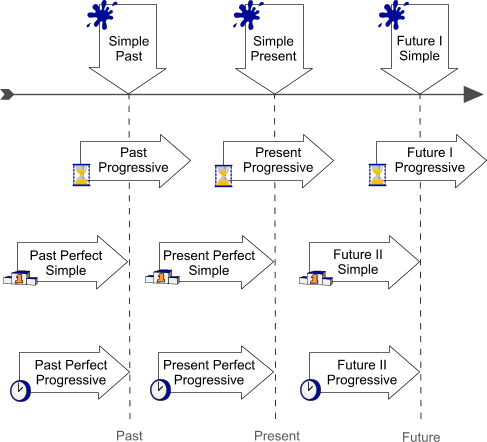
Todos os 12 Tempos Verbais – uso e explicação

Tenses

Legend

Tenses
moment in time
  • action that takes place once, never or several times
  • actions that happen one after another
  • actions that suddenly take place
Tenses
period of time
  • action that started before a certain moment and lasts beyond that moment
  • actions taking place at the same time
Tenses
Result
  • action taking place before a certain moment in time
  • puts emphasis on the result
Tenses
Course / Duration
  • action taking place before a certain moment in time
  • puts emphasis on the course or duration of the action