Alguns de meus queridos alunos que com esforço e dedicação terminaram mais um ano letivo. Parabéns a todos!
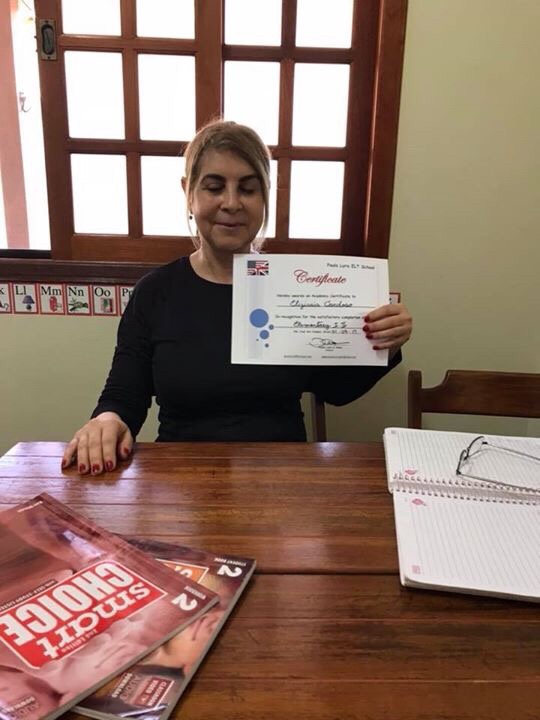
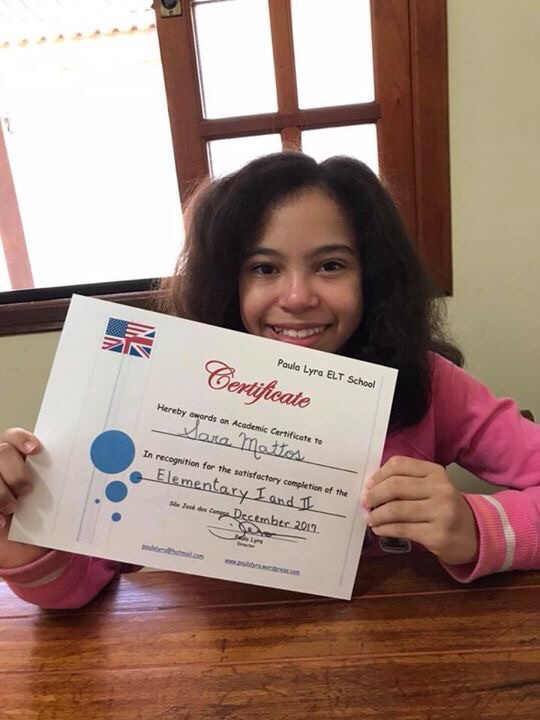
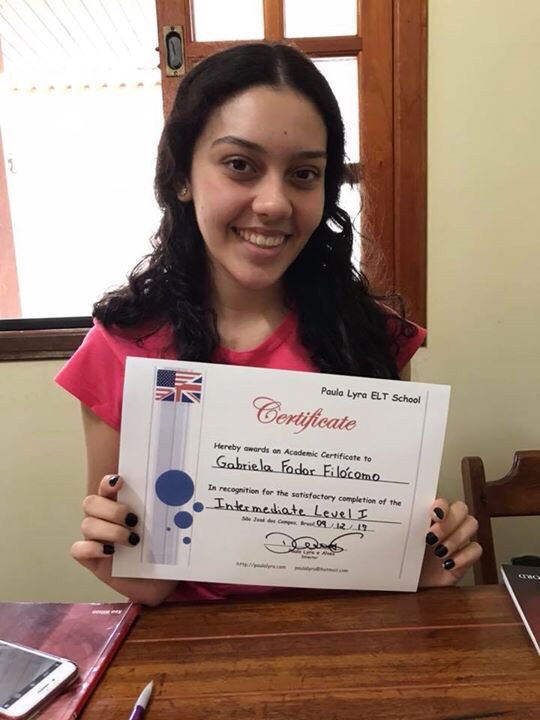


Alguns de meus queridos alunos que com esforço e dedicação terminaram mais um ano letivo. Parabéns a todos!
Algumas dessas tradições, nós tbm fazemos no Brasil, outras já estudamos durante as aulas. Vale conferir e praticar sua leitura.
Many New Year traditions that we take for granted actually date back to ancient times. This year, ring out the old and ring in the new with a new New Year tradition—or two!
MAKE SOME NOISE
Making a lot of noise—from fireworks to gun shots to church bells—seems to be a favorite pastime around the world.
• In ancient Thailand, guns were fired to frighten off demons.
• In China, firecrackers routed the forces of darkness.
• In the early American colonies, the sound of pistol shots rang through the air.
• Today, Italians let their church bells peal, the Swiss beat drums, and the North Americans sound sirens and party horns to bid the old year farewell.
EAT LUCKY FOOD
Many New Year traditions surround food. Here are a few:
• The tradition of eating 12 grapes at midnight comes from Spain. Revelers stuff their mouths with 12 grapes in the final moments of the year—one grape for every chime of the clock!
• In the southern US, black-eyed peas and pork foretell good fortune. See our recipe for Good Luck Hoppin’ John!
• In Scotland—where Hogmanay is celebrated—people parade down the streets swinging balls of fire.
• Eating any ring-shaped treat (such as a doughnut) symbolizes “coming full circle” and leads to good fortune. In Dutch homes, fritters called olie bollen are served.
• The Irish enjoy pastries called bannocks.
• In India and Pakistan, rice promises prosperity.
• Apples dipped in honey are a Rosh Hashanah (Jewish New Year) tradition.
• In Swiss homes, dollops of whipped cream, symbolizing the richness of the year to come, are dropped on the floors—and allowed to remain there!
HAVE A DRINK
Although the pop of a champagne cork signals the arrival of the New Year around the world, some countries have their own beverage-based traditions.
• Wassail, a punch-like drink named after the Gaelic term for “good health,” is served in some parts of England.
• Spiced “hot pint” is the Scottish version of Wassail. Traditionally, the Scots drank to each others’ prosperity and also offered this warm drink to neighbors along with a small gift.
• In Holland, toasts are made with hot, spiced wine.
GIVE A GIFT
New Year’s Day was once the time to swap presents.
• Gifts of gilded nuts or coins marked the start of the new year in Rome.
• Eggs, the symbol of fertility, were exchanged by the Persians.
• Early Egyptians traded earthenware flasks.
• In Scotland, coal, shortbread and silverware were traditionally exchanged for good luck.
PUT YOUR BEST FOOT FORWARD
In Scotland, the custom of first-footing is an important part of the celebration of Hogmanay, or New Year’s Eve Day.
After midnight, family and friends visit each other’s home. The “first foot” to cross a threshold after midnight will predict the next year’s fortune. Although the tradition varies, those deemed especially fortunate as “first footers” are new brides, new mothers, those who are tall and dark (and
handsome?) or anyone born on January 1.
TURN OVER A NEW LEAF
The dawn of a new year is an opportune time to take stock of your life.
• Jews who observe Rosh Hashanah make time for personal introspection and prayer, as well as visiting graves.
• Christian churches hold “watch-night” services, a custom that began in 1770 at Old St. Georges Methodist Church in Philadelphia.
• The practice of making New Year’s resolutions, said to have begun with the Babylonians as early as 2600 B.C., is another way to reflect on the past and plan ahead.
NEW YEAR’S FOLKLORE
Some customs and beliefs are simply passed down through the ages. Here are some of our favorite age-old sayings and proverbs.
• On New Year’s Eve, kiss the person you hope to keep kissing.
• If New Year’s Eve night wind blow south, It betokeneth warmth and growth.
• For abundance in the new year, fill your pockets and cupboards today.
• If the old year goes out like a lion, the new year will come in like a lamb.
• Begin the new year square with every man. [i.e., pay your debts!] –Robert B. Thomas, founder of The Old Farmer’s Almanac
So, whether we resolve to return borrowed farm equipment (as did the Babylonians) or drop a few pounds, we’re tapping into an ancient and powerful longing for a fresh start!
HAPPY NEW YEAR!!!!
Um pouco de algo …
Citações favoritas de Madre Teresa:
“A fome de amor é muito mais difícil de remover do que a fome de pão”.
“Se você não pode alimentar uma centena de pessoas, então alimente apenas uma”.
“Vamos sempre nos conhecer com um sorriso, pois o sorriso é o começo do amor”.
“Nós mesmos sentimos que o que estamos fazendo é apenas uma gota no oceano. Mas o oceano seria menor por causa dessa gota perdida”.
“Seja fiel em pequenas coisas porque é nelas que a sua força está”.
“Espalhe o amor em qualquer lugar que você vá. Não deixe ninguém vir até você sem deixa-lo mais feliz”.
“Nunca seremos capazes de saber tudo o que um simples sorriso pode fazer”.
“Toda vez que você sorri para alguém, é uma ação de amor, um presente para essa pessoa, uma coisa bonita”.
 Você sabia disso!
Um recente estudo de uma universidade sueca descobriu que partes do cérebro de estudantes de idiomas desenvolveu e aumentou em tamanho enquanto que o dos alunos regulares, não!
Leia a matéria completa abaixo.
Language learning makes the brain grow
Have you ever thought that learning new languages would help develop your brain?
A recent study at Lund University in Sweden investigated the effect on the brains of students who were learning a new language intensively compared to other students who were studying intensively, but not languages. Remarkably, they discovered that parts of the language learners’ brains had increased in size, while this was not the case for the non-language learning group.
At the Swedish Armed Forces Interpreter Academy in the city of Uppsala, young people with a flair for languages go from having no knowledge of a language such as Arabic, Russian or Dari to speaking it fluently in the space of 13 months. From morning to evening, weekdays and weekends, the recruits study at a pace unlike on any other language course.
Young recruits learn a new language at a very fast pace. By measuring their brains before and after the language training, a group of researchers have had an almost unique opportunity to observe what happens to the brain when we learn a new language in a short period of time.
As a control group, the researchers used medicine and cognitive science students at Umea University – students who also study hard, but not languages. Both groups were given MRI scans before and after a three-month period of intensive study. While the brain structure of the control group remained unchanged, specific parts of the brain of the language students grew. The parts that developed in size were the hippocampus, a deep-lying brain structure that is involved in learning new material and spatial navigation, and three areas in the cerebral cortex.
“We were surprised that different parts of the brain developed to different degrees depending on how well the students performed and how much effort they had had to put in to keep up with the course”, says Johan Martensson, a researcher in psychology at Lund University, Sweden.
Students with greater growth in the hippocampus had better language skills than the other students. In students who had to put more effort into their learning, greater growth was seen in an area of the motor region of the cerebral cortex. The areas of the brain in which the changes take place are linked to how easy it is to learn a new language. The development varies according to individual performance.
Previous research from other groups has indicated that Alzheimer’s disease has a later onset in bilingual or multilingual groups.
“Even if we cannot compare three months of intensive language study with a lifetime of being bilingual, there is a lot to suggest that learning languages is a good way to keep the brain in shape”, says Johan Martensson.
Source: http://www.teachingenglish.org.uk/top-stories/language-learning-makes-your-brain-grow
Muitos alunos me perguntam como saber quando usar e ING ou TO na hora de escolher o tempo verbal mais apropriado . No entanto a regra é mais de memorizar do que de entender.
Abaixo segue uma pequena lista com alguns verbos que pedem o gerúndio e outros que pedem o infinitivo.
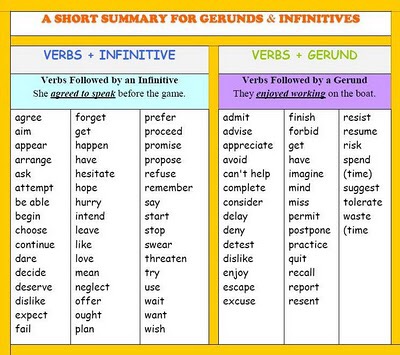
Seguem alguns exemplos:
When two verbs are used together, the second verb is often in the gerund form (-ing) or the infinitive. There are no specific rules concerning which verbs take which form. Like irregular verbs, you will need to learn which form a verb takes.
Common Verbs + ‘ing’
go
enjoy
quit
discuss
mind
can’t stand
suggest
Examples:
They go jogging on Saturdays.
I don’t mind helping you.
They can’t stand driving in traffic jams.
Common Verbs + Infinitive
promise
plan
refuse
want
need
decide
hope
Examples:
I promised to help him.
Alice needs to start that task.
He decided to quit his job.
 Saber usar ou entender expressões idiomáticas em Inglês é importante e difícil.
Seguem algumas explicações e frases com exemplos interessantes.
The following idioms and expressions use the noun ‘head’. Each idiom or expression has a definition and two example sentences to help understanding of these common idiomatic expressions with ‘head’.
able to do something standing on one’s head -> do something very easily and without effort
He’s able to count backward standing on his head.
Don’t worry about that. I can do it standing on my head.
bang your head against a brick wall -> do something without any chance of it succeeding
I’ve been banging my head against a brick wall when it comes to finding a job.
Trying to convince Kevin is like banging your head against a brick wall.
beat something into someone’s head -> teach someone something by repeating it over and over again
Sometimes you just need to beat grammar into your head.
My father beat the importance of kindness into my head.
bite someone’s head off -> criticize someone strongly
Tim bit my head off last night at the party.
Don’t bit my head off just because I made a mistake.
bring something to a head -> cause a crisis to happen
We need to bring the situation to a head to get a resolution.
The immigration situation brought the political crisis to a head.
bury one’s head in the sand -> ignore something completely
You’re going to have to face the situation and not bury your head in the sand.
He chose to bury his head in the sand and not confront her.
can’t make heads or tails out of something -> not be able to understand something
I hate to admit that I can’t make heads or tails out of this math problem.
The politicians can’t make heads or tails out of the current employment crisis.
drum something into someone’s head -> repeat over and over until someone learns something
I had to drum German grammar into my head for two years before I could speak the language.
I suggest you drum this into your head for the test next week.
fall head over heels in love -> fall deeply in love
She fell head over heals in love with Tom.
Have you ever fallen head over heels in love?
from head to toe -> dressed or covered in something completely
He’s dressed in blue from head to toe.
She’s wearing lace from head to toe.
get a head start on something -> begin doing something early
Let’s get a head start on the report tomorrow.
She got a head start on her homework immediately after school.
get your head above water -> keep going in life despite many difficulties
If I can find a job I’ll be able to get my head above water.
Study these pages and you’ll get your head above water.
get someone or something out of one’s head -> remove someone or something from your thoughts (often used in the negative)
I’m really upset that I can’t get her out of my head.
She spent three years getting those experiences out of her head.
give someone a head’s start -> let someone else begin before you in a competition of some kind
I’ll give you twenty minutes head’s start.
Can you give me a head’s start?
go over someone’s head -> not be able to understand something
I’m afraid the joke went over her head.
I’m afraid the situation goes over my head.
go to someone’s head -> make someone feel better than others
His good grades went to his head.
Don’t let your success go to your head. Stay humble.
have a good head on your shoulders -> be intelligent
She’s got a good head on her shoulders.
You can trust him because he’s got a good head on his shoulders.
head someone or something off -> arrive before someone or something else
Let’s head them off at the pass.
We need to head the problem off.
hit the nail on the head -> be exactly right about something
I think you hit the nail on the head.
His answer hit the nail on the head.
in over one’s head -> do something that is too difficult for a person
I’m afraid Peter is in over his head with Mary.
Do you ever feel that your in over your head?
lose your head -> become nervous or angry
Don’t lose your head over the situation.
She lost her head when he told her he wanted a divorce.

There are lots of ready-made materials available for you from different websites.
Look at the materials below and choose one that you think would be good to use.
This is a song.
This is an audio series.
This is a game.
This is a short video to explain language.
This is a short video and lesson plan.
Não desista de seu sonho de falar Inglês
PARA
Ainda há tempo. Você merece!
Fale comigo e aprenda no seu ritmo, com uma profissional exclusiva para as suas necessidades.

Reading quickly to get a general understanding of a written text, eg reading a description of a city to find out if it sounds like somewhere you’d like to visit.
Searching for a particular piece of information in a written text, eg reading a description of a city only to find out which country it’s in.
Reading or listening more carefully so that you get a full understanding of the text, eg reading a description of a city to find out everything about it.
Getting a general understanding of something you hear, eg listening to the weather forecast and deciding you might need to take an umbrella when you go out.
Listening for a particular piece of information, eg listening to the weather forecast to find out what the temperature will be tomorrow.
Making guesses about what is not stated explicitly in a text, eg listening or reading a conversation and deciding that the people are brother and sister without them saying so.
Organising ideas in a logical way when speaking or writing so that the listener or reader can follow our ideas.
Joining sentences together using words like and, but and because so our language flows more easily.
Strategies we use when we are speaking, eg showing you are listening to other people by saying things like, mmmm or uh-uh or oh!
An interactive strategy which is about knowing when you can join in a conversation and signalling when you think someone else should speak.
For speaking; this is speaking without a lot of hesitation and too many long pauses. For writing; this means you can write without stopping for a long time to think about what to write.
© UCLES 2016

