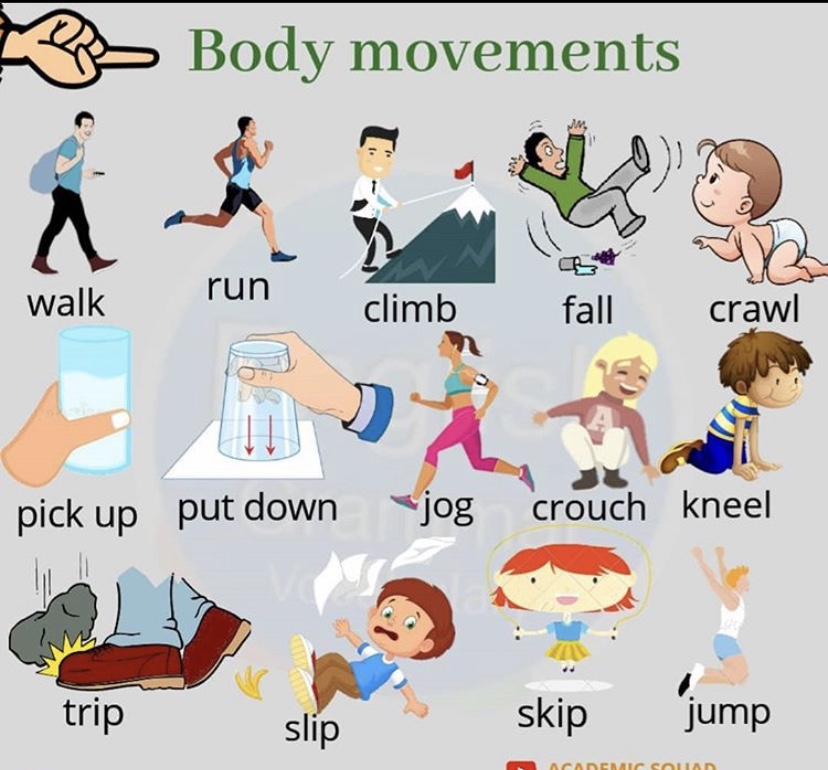
Study some of the verbs related to movement so you can use them during your conversation practice. 👍😃

Study some of the verbs related to movement so you can use them during your conversation practice. 👍😃
© The University of Sheffield
A number of employers have introduced ‘strength-based questions’ into interviews. They focus on what you enjoy doing and what you are particularly good at rather than what you can do, so be prepared to be open and honest.
Consider your achievements not just in your studies and at work but also in activities such as sports, interest groups or volunteering. Think about what aspects you enjoy and why you are good at them. This should help you to understand your strengths and prepare you for strength-based questions.
Types of questions that are looking for strengths include:
In describing your strengths, you may be able to provide evidence of the skills and experience asked for in the job description, such as team work, project work, communication skills or customer service.
For example:
Use the comments below if you can think of other strength-based questions, and how you might answer them.
© The University of Sheffield
To summarise, if you are to be interviewed for a job you should understand:
If you have applied for a course, you may be invited for an interview, although this varies between departments and at different universities or colleges. If you have applied to do postgraduate research you will almost always be invited to interview.
Before you attend, you should understand:
© The University of Sheffield
Watch, learn and practice to master!
Confira essas cinco dicas com base em nosso documento de posição de habilidades globais!
1. Tente usar eventos nas notícias para organizar um debate ou discussão em sala de aula! Por exemplo, você pode pedir aos alunos que realizem um debate sobre as mudanças climáticas. Isso também desenvolverá suas habilidades de cidadania e comunicação!
2. Tente fazer perguntas abertas que permitam múltiplas respostas, como “Quais são as quatro coisas interessantes que você fez nas férias?” Isso deixará espaço para análise e interpretação, incentivando os alunos a pensar de forma crítica e criativa.
3. O trabalho do projeto é uma ótima maneira de ensinar habilidades globais como criatividade, pensamento crítico e colaboração! Ao trabalhar em grupos, definir sua própria agenda e personalizar sua abordagem, os alunos se sentem mais envolvidos e desenvolvem várias habilidades ao mesmo tempo.
4. Não sabe por onde começar? Comece pequeno! Todas as lições incluem uma curta atividade de aprendizado de idiomas que inclua o foco na criatividade ou no pensamento crítico.
Mais tarde, você pode passar para atividades mais focadas e aprofundadas, incluindo o trabalho do projeto.
5. Tente pedir aos alunos que criem um relatório digital sobre uma questão global como mudança climática ou desigualdade! Isso os ajudará a pensar criticamente e a aprender a resolver problemas. Eles poderiam gravar o relatório em um dispositivo móvel e compartilhá-lo com seus colegas de classe para obter feedback.
In English
Do you teach Creativity and Critical Thinking?
Check out these five top tips based on our Global Skills position paper!
1. Try using events in the news to hold a debate or discussion in class! For example, you could ask students to hold a debate on climate change. This will also develop their citizenship and communication skills!
2. Try asking open-ended questions that allow for multiple responses, such as “What are four interesting things you did on holiday?” This will leave room for analysis and interpretation, encouraging students to think critically and creatively.
3. Project work is a great way to teach global skills like creativity, critical thinking, and collaboration! By working in groups, setting their own agenda, and personalizing their approach, learners feel more engaged and develop multiple skills at once.
4. Not sure where to begin? Start small! Every lesson, include a short language-learning activity than includes a focus on creativity or critical thinking.
Later, you can move on to more focused, in-depth activities, including project work.
5. Try asking your learners to create a digital report on a global issue like climate change or inequality! This will help them think critically and learn to solve problems. They could record the report on a mobile device and share it with their classmates for feedback.
Source: Oxford University Press
Assista ao vídeo e entenda a história
As primeiras origens e história
O termo “sexta-feira negra” foi realmente associado à crise financeira, não às compras de vendas.
Dois financistas de Wall Street, Jim Fisk e Jay Gould, compraram juntos uma quantidade significativa de ouro dos EUA na esperança de que o preço global subisse e, por sua vez, pudessem vendê-lo com lucros enormes.
Na sexta-feira, 24 de setembro de 1869, no que foi chamado de “Black Friday”, o mercado de ouro dos EUA entrou em colapso e as ações de Fisk e Gould deixaram os barões de Wall Street em falência.
Não foi até anos posteriores que o período pós-Ação de Graças se associou ao nome.
Nos últimos anos, circulou um boato impreciso, sugerindo que os proprietários de plantações do sul poderiam comprar escravos a um preço com desconto após o Dia de Ação de Graças, no século XIX.
Dialogue explaining which nations form the UK.
Man: So where are you from?
Woman: Scotland. Are you Scottish too?
Man: Well, no, I’m English actually, but, you know, it’s all, like, the same thing, isn’t it?
Woman: Not exactly.
Man: Go on! Isn’t Scotland just like, well, a bit of England?
Woman: No, it is not!
Man: Sorry, Britain I mean.
Woman: Britain is not England!
Man: Well, yeah, I know that. I’m not stupid or anything, but Britain’s, like, England, Scotland and Wales, isn’t it?
Woman: Not exactly.
Man: Yeah, it is – the UK, the United Kingdom.
Woman: The United Kingdom is Scotland, England, Wales and Northern Ireland.
Man: Oh, I see, but we’re all, like, the same nation, aren’t we?
Woman: Not really. Four nations, one state.
Man: Oh, I get it! So the UK (is), like, the same as Great Britain.
Woman: Great Britain is a geographical term – it’s a big island with Scotland, England and Wales on it.
Man: All right, but we all have the same prime minister, don’t we?
Woman: Yes, and the same head of state.
Man: The Queen!
Woman: Exactly.
Man: And the same government?
Woman: Well, Scotland, Wales and Northern Ireland have their own local parliaments.
Man: Oh. I see.
Woman: It’s complicated.
Man: Yeah, I can see that.
Excelente vídeo com uma mensagem maravilhosa sobre a palestra da menina Greta
Four primary ways to nurture this kind of intrinsic motivation:
So, what can these elements look like in literacy instruction?
AUTONOMY
Autonomy can be promoted by:
COMPETENCE
Some ways to help students feel like they developing more skills include:
RELEVANCE
Students can see that reading and writing can be connected to their lives in many ways, including:
RELATEDNESS
There are several ways to help students connect to each other while reading and writing. A few are:
None of these strategies are guaranteed ways to help every student in your class feel motivated to read and write in English, but they are certainly unlikely to make them feel less energized to do so!
 Paula Lyra ELT School