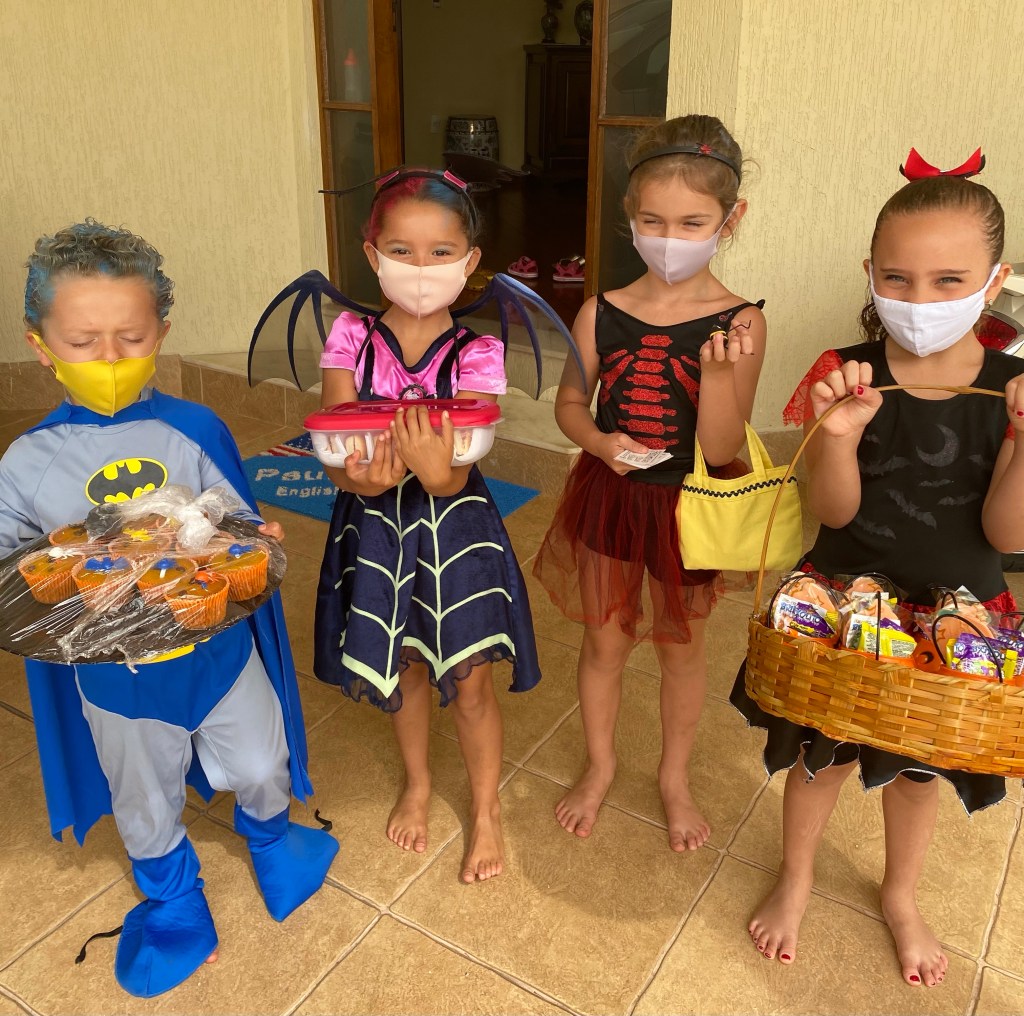
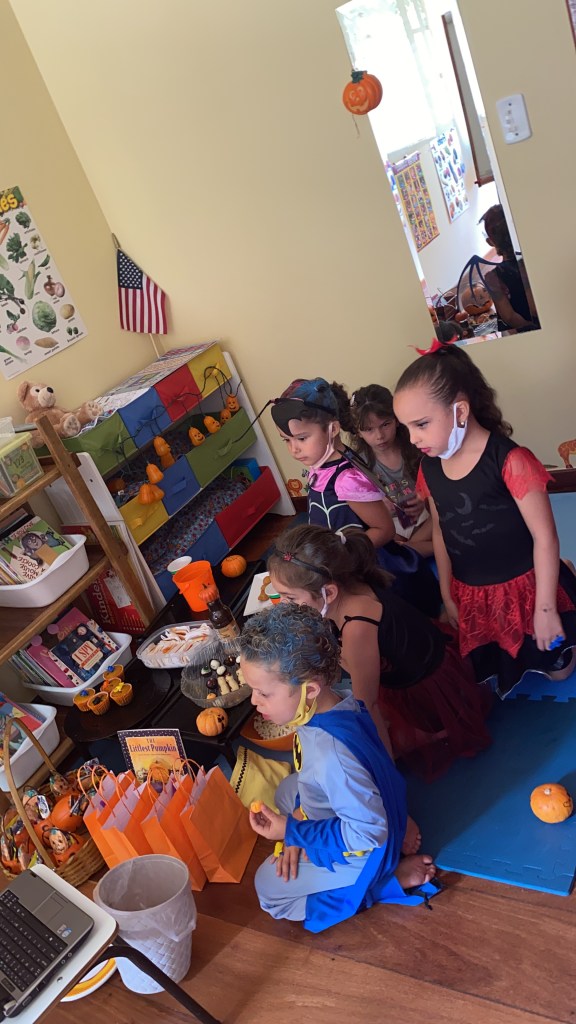
The party was great!
The food was “spooktacular”!
Everyone had fun and enjoyed a lot!


The party was great!
The food was “spooktacular”!
Everyone had fun and enjoyed a lot!


Young children learn in an integrated way and not in neat, tidy compartments. A child making shapes out of plasticine is learning maths (shape) and art (texture, shape, design, colour), building fine motor skills (physical development), and hearing or using language to describe shapes, colour, texture, materials and techniques (English). The activity drives the need to communicate.
Young children will learn a language better when they see a genuine need for communication, which is often the language they are hearing or using while they are doing an activity that they enjoy.
While adults can plan a range a activities to enhance the learning experience, not all of them will be motivating for every child. Children more likely to be motivated if the activity or experience is meaningful to them. Taking time to get to know the children and finding out what they are interested in is essential if you want to motivate them and help them learn.
The interactions you have with a child while they are engaged in an activity help develop language and communication in context, making the language learning more memorable and authentic.
Rhymes, songs and chants help children memorise words and sentence structure, and they also help with pronunciation, expression and the rhythm of sentences. Children learn their home language by playing with language in this way, and it’s a fun way for them to learn another language too!
A good story takes children to an imaginary world filled with characters and events that will make them want to find out what happens in the end, and that they will want to hear again, join in retelling, and even retell in their own words. Illustrations and actions help children understand descriptions of characters and events, because they can connect what they are seeing and doing with the language in the story.
Giving clear, simple instructions in English with accompanying actions, gestures or demonstrations is more likely to result in children understanding. Children love copying – the teacher, their parents, older siblings or friends – and will often join in after observing how something is done. Including routines is also a useful way of helping young children understand what is expected of them (e.g. every time we sit on the mat we will hear a story or sing a song). Children may not understand straight away, but giving instructions in English is an excellent way of reinforcing key language, so in the long run it’s worth the effort.

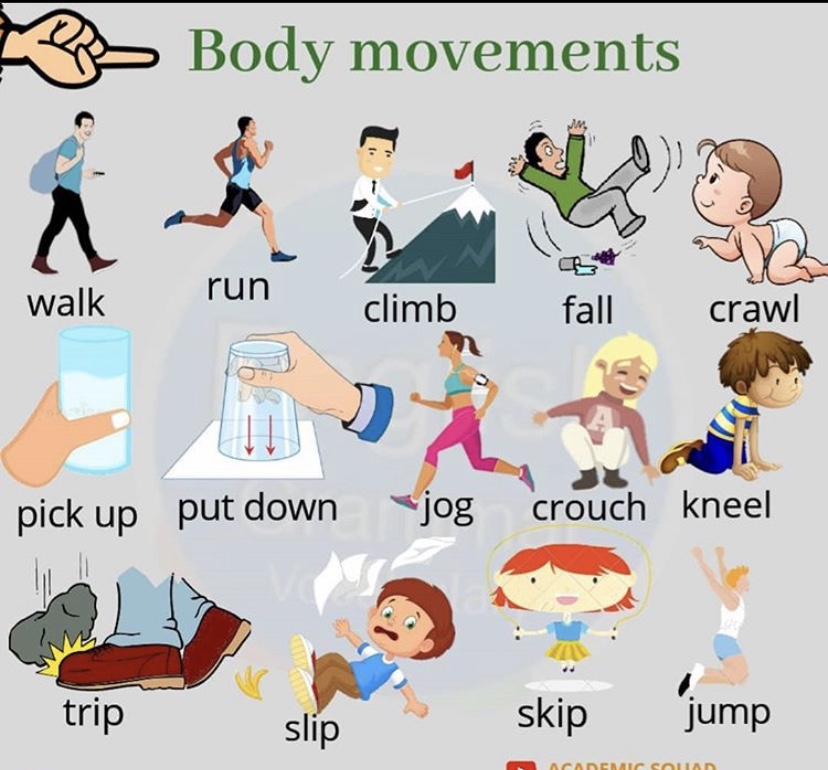
Study some of the verbs related to movement so you can use them during your conversation practice. 👍😃

Reading for gist/Skimming
Reading quickly to get a general understanding of a written text, eg reading a description of a city to find out if it sounds like somewhere you’d like to visit.
Searching for a particular piece of information in a written text, eg reading a description of a city only to find out which country it’s in.
Reading or listening more carefully so that you get a full understanding of the text, eg reading a description of a city to find out everything about it.
Getting a general understanding of something you hear, eg listening to the weather forecast and deciding you might need to take an umbrella when you go out.
Listening for a particular piece of information, eg listening to the weather forecast to find out what the temperature will be tomorrow.
Making guesses about what is not stated explicitly in a text, eg listening or reading a conversation and deciding that the people are brother and sister without them saying so.
Organising ideas in a logical way when speaking or writing so that the listener or reader can follow our ideas.
Joining sentences together using words like and, but and because so our language flows more easily.
Strategies we use when we are speaking, eg showing you are listening to other people by saying things like, mmmm or uh-uh or oh!
An interactive strategy which is about knowing when you can join in a conversation and signalling when you think someone else should speak.
For speaking; this is speaking without a lot of hesitation and too many long pauses. For writing; this means you can write without stopping for a long time to think about what to write.
© UCLES 2016
© The University of Sheffield
A number of employers have introduced ‘strength-based questions’ into interviews. They focus on what you enjoy doing and what you are particularly good at rather than what you can do, so be prepared to be open and honest.
Consider your achievements not just in your studies and at work but also in activities such as sports, interest groups or volunteering. Think about what aspects you enjoy and why you are good at them. This should help you to understand your strengths and prepare you for strength-based questions.
Types of questions that are looking for strengths include:
In describing your strengths, you may be able to provide evidence of the skills and experience asked for in the job description, such as team work, project work, communication skills or customer service.
For example:
Use the comments below if you can think of other strength-based questions, and how you might answer them.
© The University of Sheffield
To summarise, if you are to be interviewed for a job you should understand:
If you have applied for a course, you may be invited for an interview, although this varies between departments and at different universities or colleges. If you have applied to do postgraduate research you will almost always be invited to interview.
Before you attend, you should understand:
© The University of Sheffield
Watch, learn and practice to master!
Esse será o ano chinês do Rato. Um animal silencioso, rápido e que sabe se multiplicar!
Seguem alguns provérbios chineses para inspiração nesse novo ano.
Some Chinese proverbs:
If you want happiness for an hour, take a nap. If you want happiness for a day, go fishing. If you want happiness for a year, inherit a fortune. If you want happiness for a lifetime, help somebody.
Keep a green tree in your heart and perhaps the singing bird will come.
When there is light in the soul there is beauty in the person. When there is beauty in the person, there is harmony in the home. When there is harmony in the home, there is honour in the nation. When there is honour in the nation, there is peace in the world.
If you chase two rabbits, both will escape.
A book is like a garden carried in the pocket.
A child’s life is like a piece of paper on which every person leaves a mark.
Be the first to the field and the last to the couch.
A bird does not sing because it has an answer. It sings because it has a song.
A bit of fragrance clings to the hand that gives flowers.
If you always give you will always have.
To succeed, consult three old people. Teachers open the door; you enter by yourself.
He who asks is a fool for five minutes, but he who does not ask remains a fool forever.
To know the road ahead, ask those coming back.

Source: Activity Village
Confira essas cinco dicas com base em nosso documento de posição de habilidades globais!
1. Tente usar eventos nas notícias para organizar um debate ou discussão em sala de aula! Por exemplo, você pode pedir aos alunos que realizem um debate sobre as mudanças climáticas. Isso também desenvolverá suas habilidades de cidadania e comunicação!
2. Tente fazer perguntas abertas que permitam múltiplas respostas, como “Quais são as quatro coisas interessantes que você fez nas férias?” Isso deixará espaço para análise e interpretação, incentivando os alunos a pensar de forma crítica e criativa.
3. O trabalho do projeto é uma ótima maneira de ensinar habilidades globais como criatividade, pensamento crítico e colaboração! Ao trabalhar em grupos, definir sua própria agenda e personalizar sua abordagem, os alunos se sentem mais envolvidos e desenvolvem várias habilidades ao mesmo tempo.
4. Não sabe por onde começar? Comece pequeno! Todas as lições incluem uma curta atividade de aprendizado de idiomas que inclua o foco na criatividade ou no pensamento crítico.
Mais tarde, você pode passar para atividades mais focadas e aprofundadas, incluindo o trabalho do projeto.
5. Tente pedir aos alunos que criem um relatório digital sobre uma questão global como mudança climática ou desigualdade! Isso os ajudará a pensar criticamente e a aprender a resolver problemas. Eles poderiam gravar o relatório em um dispositivo móvel e compartilhá-lo com seus colegas de classe para obter feedback.
In English
Do you teach Creativity and Critical Thinking?
Check out these five top tips based on our Global Skills position paper!
1. Try using events in the news to hold a debate or discussion in class! For example, you could ask students to hold a debate on climate change. This will also develop their citizenship and communication skills!
2. Try asking open-ended questions that allow for multiple responses, such as “What are four interesting things you did on holiday?” This will leave room for analysis and interpretation, encouraging students to think critically and creatively.
3. Project work is a great way to teach global skills like creativity, critical thinking, and collaboration! By working in groups, setting their own agenda, and personalizing their approach, learners feel more engaged and develop multiple skills at once.
4. Not sure where to begin? Start small! Every lesson, include a short language-learning activity than includes a focus on creativity or critical thinking.
Later, you can move on to more focused, in-depth activities, including project work.
5. Try asking your learners to create a digital report on a global issue like climate change or inequality! This will help them think critically and learn to solve problems. They could record the report on a mobile device and share it with their classmates for feedback.
Source: Oxford University Press