Por quê eu não consigo aprender Inglês?

Muitas alunos me perguntam por que têm tanta dificuldade em aprender inglês. Eu sempre respondo que, a professora é só um dos meios de aprendizagem. Se não houver engajamento do aluno em estudar, ler, escutar músicas, assistir séries, conversar com nativos, esse aprendizado será mais difícil.

Segue um texto com excelente explicação sobre esse tema. Não deixem de ler.

A lista abaixo resume como o envolvimento com o idioma pode ser observado. Lembre-se de que os alunos também podem se engajar em maneiras que não são observáveis e, inversamente, podem fingir estar engajados para satisfazer o professor.

Critérios para identificar o envolvimento com a linguagem (EWL) (Svalberg, 2012: 378, adaptado de Svalberg 2009: 247)

Cognitivo

Quão alerta é o aluno?

O aluno parece enérgico ou letárgico?

Ele parece notar os recursos de linguagem / interação?

Como focado?

A atenção do aluno está na linguagem (como objeto ou meio) ou não?

A mente do aprendiz parece vagar?

Quão reflexivo? Quão crítico / analítico?

O raciocínio do aprendiz é indutivo ou baseado em memória / imitação?

O aluno percebe e reflete ou simplesmente reage?

Com relação à língua-alvo, o aluno compara, faz perguntas, infere / tira conclusões?

Afetivo

Quão disposto é o aluno a se envolver com a linguagem?

O aluno é retirado ou ansioso para participar?

Quão proposital?

O aluno parece entediado ou não focado na tarefa, ou estar focado?

Quão autônomo?

O comportamento do aluno é dependente ou independente?

Social

Como interativo

Interage, verbalmente ou de outra forma, com os outros para aprender?

Como apoiar os outros?

por exemplo. por comportamentos verbais ou outros?

O aluno se envolve em negociação e andaimes?

Líder ou seguidor?

As interações do aluno são reativas ou iniciadas?

© Universidade de Leicester

How engagement with language might be observed

The list below summarizes how engagement with language might be observed. Remember that learners may also engage in ways that are not observable, and conversely they can pretend to be engaged in order to satisfy the teacher.

Criteria for identifying engagement with language (EWL) (Svalberg, 2012: 378, adapted from Svalberg 2009: 247)

Cognitive

How alert is the learner?

  • Does the learner seem energetic or lethargic?
  • Does he or she seem to notice language/interaction features?

How focused?

  • Is the learner’s attention on the language (as object or medium) or not?
  • Does the learner’s mind seem to wander?

How reflective?; How critical/analytical?

  • Is the learner’s reasoning inductive or memory/imitation based?
  • Does the learner notice and reflect, or simply react?
  • With regard to the target language, does the learner compare, ask questions, infer/ draw conclusions?

Affective

How willing is the learner to engage with language?

  • Is the learner withdrawn or eager to participate?

How purposeful?

  • Does the learner seem bored or not focused on the task, or to be focused?

How autonomous?

Is the learner’s behaviour dependent or independent?

Social

How interactive

  • Does he or she interact, verbally or otherwise, with others to learn?

How supportive of others?

  • e.g. by verbal or other behaviours?
  • Does the learner engage in negotiation and scaffolding?

Leader or follower?

  • Are the learner’s interactions reactive or initiating?

O Poder dos Testes

Vivemos em um mundo onde as pessoas têm opiniões diferentes sobre a sociedade. Isto é especialmente verdadeiro quando se trata de entender onde está o poder e quem o exerce.

Leia os dois extratos seguintes dos livros que abordam a questão do uso social e político dos testes de linguagem.

Extrato 1. De Elana Shohamy (2000). O poder dos testes. Longman: Harlow, pp. 15-17.

“Os usos dos resultados dos testes têm efeitos prejudiciais para os participantes, já que tais usos podem criar vencedores e perdedores, sucessos e fracassos, rejeições e aceitações. As pontuações dos testes são muitas vezes os únicos indicadores para colocar pessoas em níveis de classe, para conceder certificados e prêmios, para determinar se uma pessoa será autorizada a continuar em estudos futuros, para decidir sobre uma profissão, para participar de aulas de educação especial, para participar de honra. aulas, para ser aceito no ensino superior e para obter empregos … Os testes são usados como um método de impor certos comportamentos sobre aqueles que estão sujeitos a eles. Os testes são capazes de ditar aos participantes o que eles precisam saber, o que aprenderão e o que aprenderão. Os candidatos estão dispostos a fazê-lo, a fim de maximizar suas pontuações, tendo em conta os efeitos prejudiciais que os resultados podem ter sobre suas vidas ”

Extrato 2: Glenn Fulcher (2015). Reexaminar os testes de linguagem: uma pesquisa filosófica e social. Londres e Nova York: Routledge, p. 155.

“Embora testes e avaliações pressupor desigualdade, é uma desigualdade de resultados, não de oportunidades. Kariya e Dore (2006) fazem uma distinção entre os ‘igualitaristas comunais’ revolucionários que distribuem a renda, o prestígio e o poder igualmente entre todos os membros da sociedade, e ‘igualitaristas meritocráticos que estão interessados principalmente na igualdade de oportunidades para competir por resultados que possam ser Embora o qualificador “vastamente” possa ser questionável em uma democracia moderna, é o que hoje chamamos de igualitarismo meritocrático que motivou a compreensão vitoriana da igualdade. Significava a remoção do privilégio, a provisão de tal educação que levaria ao sufrágio universal e oportunidade para todos na sala de exame, sujeita ao impacto inevitável do background socioeconômico (como a capacidade de pagar por aulas particulares). Em suma, essas foram as características críticas de uma sociedade democrática, e o teste é uma parte essencial do mecanismo que faz com que funcione. ”(Fulcher, 2015, p. 155).

In English

The power of tests

We live in a world where people hold different views about society. This is especially true when it comes to understanding where power lies and who exercises it.

Read the following two extracts from books that address the question of the social and political use of language tests.

Extract 1. From Elana Shohamy (2000). The Power of Tests. Longman: Harlow, pp. 15 – 17.

“The uses of test results have detrimental effects for test takers since such uses can create winners and losers, successes and failures, rejections and acceptances. Test scores are often the sole indicators for placing people in class levels, for granting certificates and prizes, for determing whether a person will be allowed to continue in future studies, for deciding on a profession, for entering special education classes, for participating in honour classes, for getting accepted into higher education and for obtaining jobs….Tests are used as a method of imposing certain behaviours on those who are subject to them. Tests are capable of dictating to test takers what they need to know, what they will learn and what they will be taught. Test takers are willing to do so in order to maximize their scores, given the detrimental effects the results may have on their lives”

Extract 2: Glenn Fulcher (2015). Re-examining Language Testing: A Philosophical and Social Inquiry. London & New York: Routledge, p. 155.

“Although testing and assessment presupposes inequality, it is an inequality of outcomes, not of opportunities. Kariya and Dore (2006) make a distinction between the revolutionary ‘communal egalitarians’ who would distribute income, prestige and power equally among all members of society, and ‘meritocratic egalitarians who are interested primarily in equality of opportunity to compete for outcomes that may be vastly unequal.’ While the qualifier ‘vastly’ may be objectionable in a modern democracy, it is nevertheless what we now call meritocratic egalitarianism that motivated the Victorian understanding of equality. It meant the removal of privilege, the provision of such education as would lead to universal suffrage and opportunity for all in the examination hall, subject to the inevitable impact of socioeconomic background (such as the ability to pay for private tuition). In short, these were the critical features of a democratic society, and testing is an essential part of the mechanism that makes it work.” (Fulcher, 2015, p. 155).

Resumo da semana sobre Linguística Aplicada

Definimos lingüística aplicada como um assunto acadêmico que se concentra na análise de problemas de linguagem do mundo real. Mostramos como ela se liga à linguística, mas vai além disso para abranger uma ampla gama de campos relacionados. A Linguística Aplicada é um campo de estudo relativamente novo e ainda está evoluindo e se expandindo, o que significa que os limites entre lingüística e lingüística aplicada não são claros.

Os linguistas aplicados não apenas tentam resolver problemas de linguagem do mundo real, mas também levantam questões sobre o uso da linguagem e seu impacto social. Nesse sentido, os pesquisadores linguísticos aplicados visam ser críticos, objetivos e factuais.

Vimos algumas maneiras pelas quais a pesquisa aplicada em lingüística teve um impacto real na sociedade em geral, já que essa é uma das características distintivas da disciplina; sua aplicação a problemas da vida real onde a linguagem é central. Vimos também que uma das principais aplicações é melhorar a eficiência e a eficácia do ensino, aprendizagem e avaliação de línguas, uma área que iremos aprofundar nas próximas semanas.

In English

We’ve defined applied linguistics as an academic subject that focuses on the analysis of real world language problems. We have shown how it links to linguistics but goes beyond this to cover a broad range of related fields. Applied Linguistics is a relatively new field of study and is still evolving and expanding, which means that the boundaries between linguistics and applied linguistics are not clear cut.

Applied linguists not only try to solve real world language problems but also raise questions about language use and its social impact. In this sense, applied linguistic researchers aim to be critical as well as objective and factual.

We have looked at just a few ways that applied linguistics research has had a real impact on broader society, as this is one of the distinctive features of the discipline; its application to real life problems where language is central. We have also seen that one of the key applications is to improve the efficiency and effectiveness of language teaching, learning and assessment, which is an area that we will explore further in the following weeks.

Inglês será sempre a língua Global?

Global business speaks English

Segue excelente matéria. Não deixe de conferir.

With the continuing globalisation of trade and commerce, many organisations, from great multinationals to small companies do business around the world and need to communicate with clients and competitors, many of whom may have a different first language. Very often, the language adopted as a common language or lingua franca is English.

As a recent article in the Harvard Business Review puts it, ‘Global Business Speaks English’.

This is an additional video, hosted on YouTube.

The video is also available here if you are unable to access YouTube.

Reflection – the role of English in global business

Do you agree with Dr Tsedal Neeley about the role of English in global business? Are there any negative implications of adopting English as a company lingua franca?

What do you understand by the terms ‘dial up’ and ‘dial down’ in relation to language use? Do you agree that native speakers need to ‘dial down’ and non-native speakers need to ‘dial up’? If so, how would they do this?

Por quê ensinar Fonética é importante?

Why is phonics important?

Phonics is important in learning to read and write. Research supports the view that phonics is a key predictor of later reading success.

English is a phonetic language, which means we have a sound that is matched by a written letter or combination of written letters.

The letter b and the sound b represented by the insect beeMatching sounds to letters © QUT English is the most complex alphabetic language to learn because it is irregular – there can be many options for combining letters to create a specific sound, or combining sounds to make up a word. However, there are parts of the English language that do follow rules and it’s important that children understand these rules to be successful decoders.

Learning to read is complex and phonics is just one part of code-related literacy development and becoming literate.

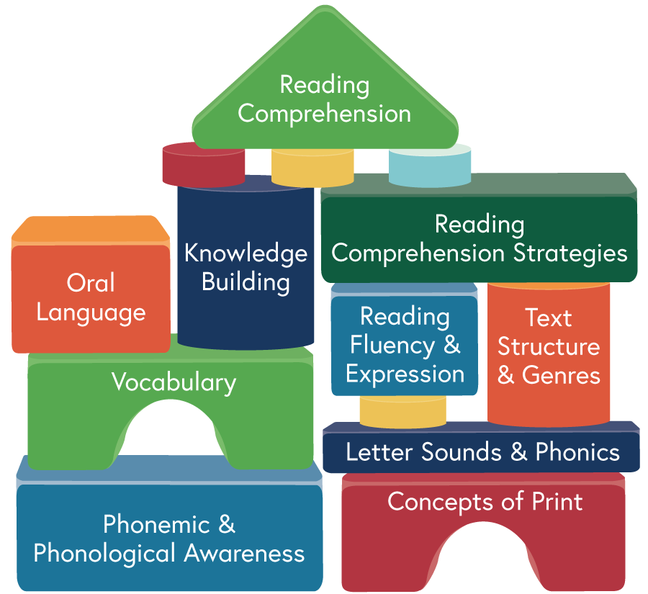
Building blocks with reading comprehension at apex; concepts related to oral language on one side and concepts related to printed language on the other side.Building blocks of literacy. Adapted from The Melissa Institute. © QUT Learning to read also involves developing strategies in all of the blocks in the image above, as well as discovering the pleasure of reading and reading for a purpose.

Oral language and phonological awareness play a key role in early childhood literacy development. Phonics knowledge is finite and can be learnt quickly, whereas comprehension and vocabulary knowledge continues to develop over a lifetime. This makes phonics learning easier to measure than comprehension and vocabulary development.

Over the past 50 years, academics, policymakers and education leaders have argued over whether we should, or should not, teach phonics. Rather than arguing whether phonics is necessary, research has shifted from ‘should we or shouldn’t we’ teach phonics, to what form of phonics should be taught, when, and how much.

There are a range of different ways you can teach phonics in your early years setting. The ‘best’ way to teach phonics is through teachers using their informed professional judgment about what’s needed for the children they’re teaching.

What is phonics?

Phonics is understanding the structure of oral language and its representation in written language. It’s a method for teaching children to read by helping them to connect sounds with letters or groups of letters. Phonics is just one part of learning to read.

Explaining phonemes

Phonemes are the smallest units of sound in oral language. The relationship between phonemes and letters is known as phoneme-grapheme correspondence – more commonly known as phonics.

Explaining phonological awareness

Phonological awareness is the ability to detect and manipulate the larger units of sound; for example, rhyme and syllables. Phonological awareness is important for children in the prior-to-school years. Research suggests it is easier to attend to larger units of sound, such as rhymes and counting syllables, than it is to attend to the smaller units of sound as in phonemic awareness.

Modais

Os verbos modais têm diferentes possibilidades. Não são fáceis de serem usados, pois necessitamos ter um entendimento desta possibilidade.

Eles podem variar de acordo com o tempo verbal ou a ênfase que se quer dar.

Por exemplo: habilidade, obrigação, permissão, sugestão, conselho, previsão, promessa, pedido, possibilidade ou decisão.

Veja alguns exemplos na imagem e entenda melhor sobre eles.

Talking about job offers

Read the text and make sure you understand all the blue words and expressions. If you’re not sure of the meaning, click on the link to read the definition.

If you are successful in a job interview, the company may make a job offer.

If the company does offer you the position and you accept the offer then you will need to talk about the terms of employment. You will need to discuss the working hours and of course the salary.

Before you start your new job, you will need to decide on the start date. This will depend on the notice period in your current job. This could mean you have to work for a number of weeks after you hand in your notice.

When you have agreed all of this, your new employer will send you a confirmation letter and you can sign a contract with them.

Business Acronyms

1 B2B – Business to Business

2 B2C – Business to Consumer

3 BD – Business Development

4 CEO – Chief Executive Officer

5 CFO – Chief Financial Officer

6 COB – Close Of Business

7 COO – Chief Operating Officer

8 CRM – Customer Relationship Management

9 CSR – Corporate Social Responsibility

10 DM – Direct Mail (can also mean Direct Message)

11 EOD – End Of Day (EO plus another letter is commonly used for End Of Week, End Of Play or End Of Thread for example)

1 HR – Human Resources

2 IAM – In A Meeting

3 FYI – For Your Information

4 KPI – Key Performance Indicator – a way of measuring something that is crucial to the success of the business

5 MOM – Month Over Month refers to that month’s figures compared with the previous month’s (also QOQ or Quarter Over Quarter and YOY or Year Over Year)

6 PA – Performance Appraisal, or it can also stand for Personal Assistant

7 PDP – Personal Development Programme

8 P/E – Price to Earnings (refers to the market price per share divided by the actual earnings per share)

9 P&L – Profit and Loss (summarises the revenue, costs and expenses earned and incurred by a business)

10 ROI – Return On Investment (also used for ROA or Return On Assets and ROE or Return On Equity)

11 SMART – Specific, Measurable, Attainable, Realistic, Time-bound is a guide used for setting an objective that can be measured

12 SMB – Small to Medium Business (also sometimes called SME or Small to Medium Enterprises)

13 TOS – Terms Of Service

14 YTD – Year To Date