
Tag Archives: aprendizado bilíngue
How to get your English to B1 level
1. Understand the main points of clear standard input on familiar matters regularly encountered in work, school, leisure, etc.
For B1 level, you should read and listen to English as much as you can. You can take English lessons, listen to English language songs, watch films and shows in English, read documents in English for your job or search for articles and videos … all of these will help you to improve your reading and listening skills.
Choose texts about things you already know. For example, read English-language websites or tourist information about your country, or watch a show or film again that you’ve already watched but this time with English audio or subtitles. Don’t worry if you don’t yet understand all of it. Focus on understanding the main points, and note down new words to increase your vocabulary.
Also, choose texts at the right level for you. On this website, for example, do readings and listenings that are marked A2 or B1. Don’t choose texts that you find too difficult, as you might feel frustrated.
2. Be able to deal with most situations likely to arise whilst travelling in an area where the language is spoken.
If you have any opportunities to travel, take advantage! Use your English to do things like buying tickets, ordering food, shopping and taking public transport.
Even if you can’t travel, there are still things you can do to improve your skills. Travel topics are usually included in English coursebooks and learning materials, so use them to prepare for these situations. A good way to practise is to first learn useful words and phrases for a situation, and then do a role play.
3. Produce simple connected text on topics which are familiar or of personal interest.
How often do you speak and write English? Try to do both regularly.
For speaking practice, try to find some English speakers in your workplace, school, local area or online, and talk to them about your interests, family, work and so on. You can also try recording yourself speaking or posting a voice message in our Learning hub. For writing practice, you might like to write a diary or blog, or write comments on the LearnEnglish Facebook page or social media.
For B1 level, you should speak and write more at length. Use words such as therefore, because, first of all and on one hand … on the other hand … to connect one idea or sentence to another.
4. Describe experiences and events, dreams, hopes and ambitions and briefly give reasons and explanations for opinions and plans.
This skill is about expressing your thoughts. Practise putting your thoughts into English.
You can try talking about your past experiences. What memorable experiences have you had, either recently or a long time ago? You might need to check some vocabulary to talk about them, so use a dictionary or translator. Then think about what you can say and practise saying it until you can describe your experience smoothly and in detail. This is also good for your vocabulary: it’s usually easier to learn vocabulary when it is personally meaningful.
Try talking about the future too. What do you plan to do this week, this year or in five years’ time? Do you have any hopes or dreams? Put these into words. If you don’t know what your future plans are, it’s fine – you can still talk about different options that you are thinking about. You can also say why you plan to do things.
As suggested above, keeping a diary or blog and having regular English conversations are good ways to practise these skills.
Good luck on your way to B1!
First Day of class 2024
Let’s have fun learning English!
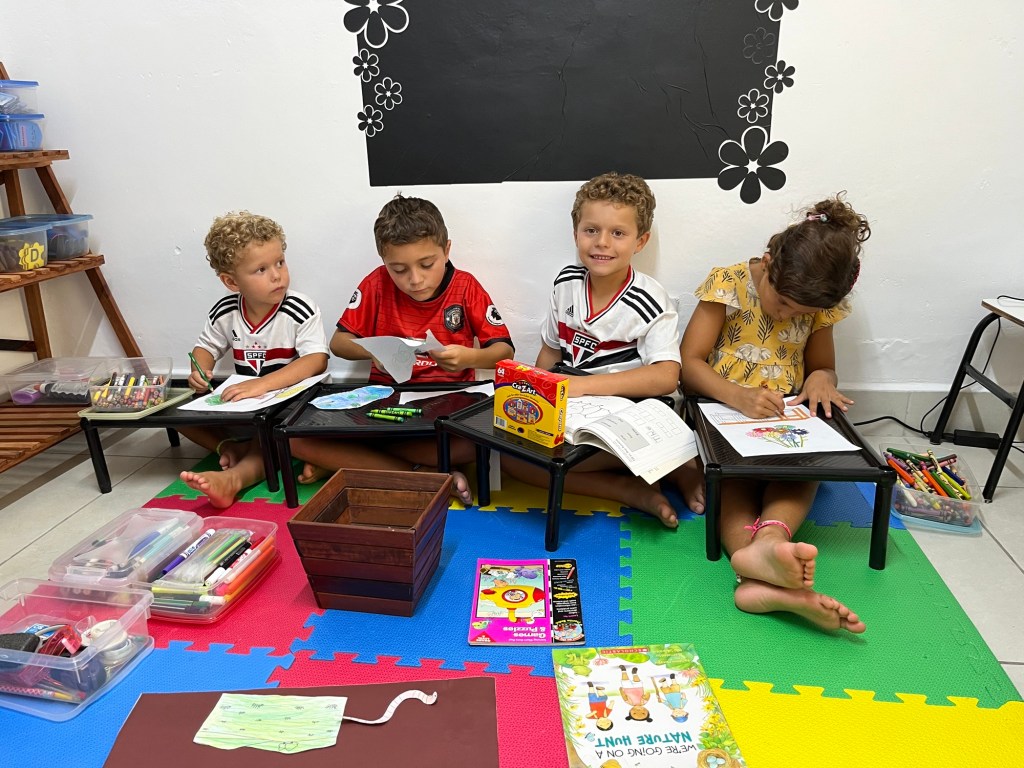
Toddlers Learning English
Children can learn a second language easily and enjoy it a lot.
Classes have to be funny and with hands on activities.
Interrogative Pronoun
Do you know how to use all the possibilities of How.
Here are some.

Some ways to use the interrogative pronoun HOW

10 Childhood Benefits Of Being Bilingual
By Nikita Gupta / July 12, 2021


Photo credit: www.growingupgupta.com
“Having your child learn two languages at the same time will confuse them, won’t it?” “You know that teaching your child multiple languages is just going to cause a speech delay?”
Have you heard these assertions too? These are common questions that many of us raising bilingual kids hear. The answer is “No” to all of the above. Learning two languages at the same time does not negatively affect speech development. On the contrary, it might help the child overcome the problem faster. To give you some assurance, here are ten benefits of being bilingual.Photo credit: www.growingupgupta.com
Benefits of Being Bilingual from a Young Age
1. Better concentration
When a bilingual child tries to speak, both languages compete to be spoken. The child has to quickly pick and suppress the other and switch between them in a second. This ability helps kids to focus better in a noisy class and mute all other irrelevant sounds.
2. Arithmetic and problem-solving
Bilingual kids have better mental alertness, which helps them to solve problems much easier. A study by psychologists Ellen Bialystok and Michelle Martin, shows that bilinguals have an easier time dividing objects by shapes and colors than their monolingual peers.
3. Creativity and ability to hypothesize
Since their brains are used to decoding and interpreting two or more languages, bilingual kids have an easier time coming up with and explaining scientific ideas.
4. Better language and vocabulary
Bilingual kids do better in word reading and spelling because of their understanding of sounds and tenses. This gives them an advantage over others when they start learning languages in class.
5. Brain exercise
In a bilingual child’s brain, both sides are always on alert and active even when they are speaking one language. The brains work a little bit more than a monolingual brain, which enhances their cognitive abilities.
6. Better communication
Multilingual kids have mastered the art of interpersonal understanding and listening, which makes them better communicators. This is more of a benefit of growing up in a multilingual environment where you have to listen to other’s perspectives and understand them.
7. Better memory
Learning two languages means you have to retain a lot of information and be ready to produce it at will. This helps kids with memory in school work as well as other important stuff like directions.
8. Faster response
Have you ever noticed that children take a while before responding to a command or an incident? Learning multiple languages forces the brain to quickly switch from one language to another, depending on who is speaking to you. As a result, the brain gets used to quick response and shorter reaction time.
9. Improved social life and better family connections
Speaking a second or third language opens up a whole new world out there to enhance your social skills. Being able to communicate with people from different cultures is a confidence boost and an ice breaker. It also helps to relate better with family members from that culture.
10. Open-mindedness
Multilingual kids are more open-minded and adaptable because you have already exposed them to a different level of tolerance. They are also more accepting and understanding of others, which translates to compassion and empathy.
At a young age, bilingual acquisition is as natural as learning how to walk or crawl. Kids who learn decoding skills in one language will easily translate to English or any other language. Multicultural parenting may not be the easiest, but it comes with many benefits for the children. As we have seen, there are multiple benefits of being bilingual.
A step-by-step guide to learning English with songs
Whatever type of music you’re into, learning English with songs will help you improve your listening and speaking skills, vocabulary and pronunciation.
1. Choose a song that’s in English
It can be any song at all. A song that you like, that you’ve listened to several times before. Have you found it? Great! Now …
2. Listen to the song
Do you understand all of the lyrics?
Probably not! But don’t worry – people hardly ever understand every word of a song the first time they hear it. The words have to fit the rhythm of the music, so they are often difficult to understand.
3. Read the lyrics
Find the lyrics online. Many music streaming services have a setting where you can listen and read the lyrics at the same time.
Listen to the song again while you read. Now it starts to make a bit more sense!
Make a note of new or interesting words and phrases. You don’t have to look up every single word in the dictionary. Try to learn five to ten new words per song.
4. Notice pronunciation
You may notice some strange-looking words! Some words in songs are written as they are pronounced.
‘Wanna’, for example, is an informal spelling of ‘want to’.
What about ‘gonna’ and ‘gimme’? What are these informal spellings of?
As you listen, notice how phrases are pronounced. This really helps you understand people when they’re talking fast.
5. Listen again and join in
As you listen, start to join in with the easier parts. Sing as quietly or as loudly as you want!
The chorus – the part of the song that is repeated several times – will probably be what you can sing along to first.
6. Sing along
Listen to the song a few more times, and each time join in with a little bit more.
By now the song is really in your head! You’re really feeling the rhythm of the music and the lyrics.
Tomorrow, next week or whenever you feel like learning a new song, do the same thing again. But don’t forget to come back to the old songs, especially your favourites.
50 Interview questions
Consider this list your interview question and answer the best way possible.
- Tell Me About Yourself.
- How Did You Hear About This Position?
- Why Do You Want to Work at This Company?
- Why Do You Want This Job?
- Why Should We Hire You?
- What Can You Bring to the Company?
- What Are Your Greatest Strengths?
- What Do You Consider to Be Your Weaknesses?
- What Is Your Greatest Professional Achievement?
- Tell Me About a Challenge or Conflict You’ve Faced at Work, and How You Dealt With It.
- Tell Me About a Time You Demonstrated Leadership Skills.
- What’s a Time You Disagreed With a Decision That Was Made at Work?
- Tell Me About a Time You Made a Mistake.
- Tell Me About a Time You Failed.
- Why Are You Leaving Your Current Job?
- Why Were You Fired?
- Why Was There a Gap in Your Employment?
- Can You Explain Why You Changed Career Paths?
- What’s Your Current Salary?
- What Do You Like Least About Your Job?
- What Are You Looking for in a New Position?
- What Type of Work Environment Do You Prefer?
- What’s Your Work Style?
- What’s Your Management Style?
- How Would Your Boss and Coworkers Describe You?
- How Do You Deal With Pressure or Stressful Situations?
- What Do You Like to Do Outside of Work?
- Are You Planning on Having Children?
- How Do You Prioritize Your Work?
- What Are You Passionate About?
- What Motivates You?
- What Are Your Pet Peeves?
- How Do You Like to Be Managed?
- Do You Consider Yourself Successful?
- Where Do You See Yourself in Five Years?
- How Do You Plan to Achieve Your Career Goals?
- What’s Your Dream Job?
- What Other Companies Are You Interviewing With?
- What Makes You Unique?
- What Should I Know That’s Not on Your Resume?
- What Would Your First 30, 60, or 90 Days Look Like in This Role?
- What Are Your Salary Expectations?
- What Do You Think We Could Do Better or Differently?
- When Can You Start?
- Are You Willing to Relocate?
- How Many Tennis Balls Can You Fit Into a Limousine?
- If You Were an Animal, Which One Would You Want to Be?
- Sell Me This Pen.
- Is There Anything Else You’d Like Us to Know?
- Do You Have Any Questions for Us?
Good luck on your interview! 🍀
Earth Day today!
Let’s celebrate!
Earth Day, which was established in 1970 in the US, is celebrated on 22nd April each year. It is a day to think about our planet and what we can do to keep it special; to think about saving water and energy, reducing pollution, recycling, protecting our animals, trees and plants, and generally getting kids interested in protecting their environment.
“Treat the Earth well. It was not given to you by your parents, it was loaned to you by your children.
Kenyan proverb

Here are some quick ideas for celebrating Earth Day with your children:
- Plant a tree
- Go for a bike ride or a long walk (leave the car behind)
- Hold a nature “scavenger hunt” (send the kids out into the garden or park in teams to collect – or spot – various items on a list you provide – we have some scavenger hunt printables you can use here!)
- Print out some of our posters and place in strategic positions around the house. Talk about saving water when brushing teeth and saving energy by turning off the lights when you leave a room
- Bake your favourite cookie or biscuit recipe and let the kids decorate with icing to look like the planet earth
- Gather family and friends together and combine a picnic or other excursion with a litter clean-up
- Set up a recycling centre in your home or school
- Look through your shelves and find some books to give away via your local charity shop or library
- Delve into your craft cupboard and tackle a recycling craft for fun!
Source: https://www.activityvillage.co.uk/earth-day?awt_a=8YG5&awt_l=5S26Y&awt_m=IpVSHZyq2VDtG5
 Paula Lyra ELT School