Anxiety when speaking in English

How to reduce anxiety when speaking English

A student looking worried

If you ever feel anxious about speaking English, here are some tips to help.

Do you ever feel scared or worried about speaking English? Perhaps you get sweaty hands or your heart starts beating fast. Those are signs that you might be feeling anxious. People often feel anxious about speaking in front of classmates, speaking to native speakers, making mistakes and various other things.

Anxiety is very common, but if the worries stop you from speaking, then you might miss opportunities to practise your English. You also can’t get much feedback on your speaking from the teacher or other people. Other people miss out on the chance to hear your ideas as well.

It takes time to overcome anxiety about speaking English, but it can be done! Here are some tips.

1. Set yourself a goal

Start small. Set a goal that is a bit challenging but achievable and not too scary. For example:

  • Say ‘How are you?’ to a classmate or an English-speaking friend.
  • Ask the teacher one question in your next class.

And here are some more challenging goals.

  • Chat with somebody for a few minutes.
  • Speak in front of an audience.
  • Speak on the phone.

Remember, the goal is not to do these things perfectly, it’s just to do them! Search for opportunities, and if you achieve your goal, that’s great! Increase the difficulty of your goals over time.

2. Think positively

Tell yourself positive things: I can do it. I’ve got this. It will be OK! Whether you are a beginner or an advanced-level speaker, thinking negatively will limit what you do. Thinking positively will help you to do your best and improve.

3. Face your fears (gently)

If you feel anxious, you may want to avoid speaking. It might be easier to do something totally different, such as reading or grammar exercises. However, avoiding the issue can just make it grow bigger and scarier. Don’t wait – start speaking little by little. It will be OK!

4. Look for a good partner

Try to find someone who you feel comfortable speaking with, perhaps somebody who is patient and kind and keen to speak English too. If you can practise speaking regularly, it should help to reduce anxious feelings.

5. Plan what to do in case of problems

We often worry about having problems like these and not knowing how to deal with them.

  • What if I forget a word?
  • What if my mind goes blank?
  • What if I don’t understand what the other person is saying?

By planning what you will do and say if these situations occur, you may feel less anxious. If you forget a word, for example, prepare some phrases such as I can’t remember the word. What I mean is … and then try to describe the word. You could perhaps use synonyms (It’s similar to …) or antonyms (It’s the opposite of …). Or if somebody says something you don’t understand, you can say Sorry, I didn’t get that or Sorry, could you say that again? Write these phrases in your notebook and practise them.

Communication is never 100 per cent smooth, not even for native speakers. Overcoming such problems is a very normal part of speaking.

6. Accept problems and mistakes

Learning a language is not easy, and you will definitely have problems and make mistakes along the way. Everybody does! But making a mistake can teach you a lot and help you to improve your skills. Remember that good speakers are not people who speak perfectly all the time. Instead, good speakers can solve communication problems when they occur. 

7. Note your progress

Over days and weeks, experiment with different ways to reduce and cope with anxiety, and keep notes of what works for you and what doesn’t. Note down your speaking goals too and tick them as you achieve them, so that you can see your progress and build up positive experiences of speaking.

8. Reward yourself

If you try hard and make progress but your reward is just to do more practice, it might not be very motivating. So, reward yourself with something nice like eating a chocolate, buying a new notebook, taking time off to relax or whatever makes you feel good. Reward yourself when you achieve a goal, overcome a problem, learn something important or do something challenging.

Source: https://learnenglish.britishcouncil.org/english-levels/improve-your-english-level/how-reduce-anxiety-when-speaking-english?utm_campaign=english-all-learnenglish-global-newsletters&utm_medium=email&_hsmi=70305096&_hsenc=p2ANqtz-_PGnZHq1Kh40PYLkh37EATnVQCYdzNIrJx6jv7I2XQRLT95u-K6EITEYtPmxIHJm5QVLiQYH4Veh3qAbtR95wLSgWzYw&utm_content=70305096&utm_source=hs_email

About the weather

Idioms related to the weather

Woman with a lot of work

If I tell you that I’m ‘snowed under’, what do you think I mean?

  1. I’m having problems with the winter weather.
  2. I’m very confused.
  3. I’ve got too much work to do.

What do you think? If you said c, that’s exactly right!

‘To be snowed under’ is an idiom – a group of words with a special meaning that is different from the meaning of each word on its own. 

There are lots of idioms in English related to weather. In this step you’ll find six useful ones that you hear and read quite often. 

Can you guess what the idioms in bold mean in each example? Then check the definitions below to see if you’re right.

He was on cloud nine when they offered him the job.
She gets up at 6 a.m., come rain or shine, and goes for her morning walk.
threw caution to the wind and followed them into the water.
The return trip was a breeze after the hard climb up the mountain.
They’re so positive and enthusiastic – it’s like a breath of fresh air working with them.
I’m totally snowed under at work this week.

Definitions

to be on cloud nine

to be extremely happy about something

He was on cloud nine when they offered him the job.

come rain or shine

whatever happens; no matter what the situation is

She gets up at 6 a.m., come rain or shine, and goes for her morning walk.

to throw caution to the wind

to do something without worrying about the risks or problems it may cause

I threw caution to the wind and followed them into the water.

to be a breeze

to be easy, especially unexpectedly easy

The return trip was a breeze after the hard climb up the mountain.

a breath of fresh air

someone or something that is new and different and makes everything seem more exciting

They’re so positive and enthusiastic – it’s like a breath of fresh air working with them.

to be snowed under

to have too much to do

I’m totally snowed under at work this week.

You can use these idioms in informal communication to make your speaking and writing more interesting

Source: https://learnenglish.britishcouncil.org/learning-hub/idioms-related-weather

Passover – Páscoa dos Judeus

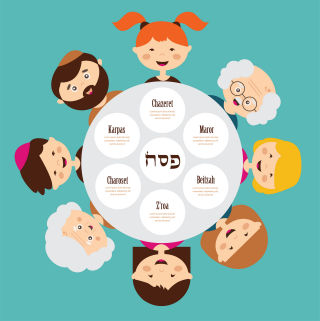
The feast of Passover, one of the most important Jewish festivals, will next be celebrated by Jews all around the world from 5th to 13th April 2023. Known as Pesach in Hebrew, Passover has been celebrated since about 1300 BC, and families coming together, from great distances if necessary, to celebrate together. The celebration last for seven or eight days depending on where you live.

Passover Seder plate

The Story of Passover

The Book of Exodus in the Old Testament of the Bible tells the story of Passover. The people of Israel had been slaves in Egypt for over years. Although God promised he would release them from slavery, it seemed that the Pharaoh (the king of Egypt) had other ideas! When Moses was a very old man, he and his brother Aaron visited Pharaoh and demanded, in the name of God, that he let their people go. Pharaoh refused, claiming that he did not recognise God. Moses warned him that God would send ten plagues to Egypt to show his power.

  • First came the Plague of Blood. The River Nile was essential for Egyptian life, so when God turned the water of the River Nile, and all the water of Egypt, into blood, the fish and crops died and the Egyptian people suffered terribly.
  • Second came the Plague of Frogs: Can you imagine if everything was covered in frogs? It sounds funny but I expect it wasn’t very nice! We have a Plague of Frogs colouring page, below.
  • After the frogs, came the the third plague, the Plague of Lice. Everything and everyone was covered in creepy crawly itchy lice.
  • Fourth came the Plague of Flies. Flies swarmed into Egypt in huge numbers and got everywhere!
  • After the flies came the fifth plague, the Plague on Livestock. All of Egypt’s animals – horses, donkeys, camels, cows, sheep and goats – died. Egyptians began to be very hungry.
  • Next God sent a Plague of Boils. Boils are very painful infected spots, and the people of Egypt and all their livestock were covered with them.
  • Can you imagine things getting worse? After the boils came the seventh plague, the Plague of Hail, with a huge hailstorm which flattened down any surviving crops. The hail stones were so big that they killed people and animals!
  • Eighth came the Plague of Locusts. Locusts swarmed into Egypt and munched up any crops which were still standing, leaving nothing behind them.
  • After that, for the ninth plague, the people of Egypt were terrified by the Plague of Darkness. The sun disappeared and for three full days Egypt went dark.

All these plagues affected only the Egyptians. God protected Moses’ people and the Israelites were unaffected. Pharaoh, however, still refused to budge, so God sent his final, terrible plague:

  • The Tenth Plague – the Plague on the First-born. God told Moses that one of his angels would go from house to house and kill every Egyptian first-born son! To save Israelite children from the same fate, Moses should tell his people to follow some very specific instructions: to kill a lamb and use its blood to make a mark on their doors, then to roast and eat the lamb with bitter herbs and unleavened (flat) bread, while dressed for a journey.

Sure enough, at midnight the angel went through Egypt and every first born son was struck down, including Pharaoh’s son. The Israelite households were passed over (which is where the name of this holiday comes from). The people of Egypt were terrified and called on Pharaoh to banish the people of Israel right away, which he did. In fact, the Israelites left in such a hurry that there wasn’t time for their bread dough to rise, which is why no risen (leavened) bread is eaten during Passover now. Moses led the people out of Egypt.

Source: https://www.activityvillage.co.uk/passover

Learning tip: Read and relax!

If you have some free time over the holidays, reading stories is an excellent way to practice and improve your English. Stories aren’t just fun to read. They also contain a wide range of language, including words, structures, styles and meanings that you may not find in other reading texts.

Bellow you can find links with some stories that were written especially for learners at different levels. Here’s some advice:

  • Don’t choose a story that is too difficult. If it’s difficult, you’ll feel confused.
  • Don’t check the dictionary a lot. It slows down your reading and makes it hard to enjoy.
  • Choose a story with some words that are new for you but whose words you mostly understand. That will allow you to enjoy the story more and also improve your reading speed.

Enjoy your reading time!

https://learnenglish.britishcouncil.org/general-english/story-zone/a2-b1-

https://learnenglish.britishcouncil.org/general-english/story-zone/b2-c1-stories

Source: https://learnenglish.britishcouncil.org/general-english/story-zone?utm_campaign=english-all-learnenglish-global-newsletters&utm_medium=email&_hsmi=66874876&_hsenc=p2ANqtz-8ej0mVCw1DFzWnvq2a0ANLaTk6fQ8kjssH8b1ykyQyCn_WtiB5ReX5kAZD0HqvK5cnesSaXjKkckCtwKEpikT7nno5hQ&utm_content=66874876&utm_source=hs_email

The origins of English

The story of the English language began in the fifth century when Germanic tribes invaded Celtic-speaking Britain and brought their languages with them. Later, Scandinavian Vikings invaded and settled with their languages too. In 1066 William I, from modern-day France, became king, and Norman-French became the language of the courts and official activity. People couldn’t understand each other at first, because the lower classes continued to use English while the upper classes spoke French, but gradually French began to influence English. An estimated 45 per cent of all English words have a French origin. By Shakespeare’s time, Modern English had developed, printing had been invented and people had to start to agree on ‘correct’ spelling and vocabulary.

Source: http://www.un.org/en/events/englishlanguageday/

Task 1: https://learnenglish.britishcouncil.org/general-english/magazine-zone/english-language-day?utm_source=newsletter&utm_medium=email&utm_campaign=english-adults-leweb-global-global-2022-04-le-newsletter#

Task 2 : https://learnenglish.britishcouncil.org/general-english/magazine-zone/english-language-day?utm_source=newsletter&utm_medium=email&utm_campaign=english-adults-leweb-global-global-2022-04-le-newsletter#

Remote teaching tips

This publication offers a range of practical tips and advice for remote teaching in all contexts.

Technology has already transformed our century. Smartphones, cloud computing, social media and videoconferencing are only a few of the major innovations that have exploded onto the scene. They have changed our lives and completely changed the ways in which we communicate and access information and learning. 

Yet in 2020 teachers have also had to face another unexpected challenge – the Covid-19 pandemic. We know many children have missed learning during school closures and too many lack the conditions for remote learning. But the more that teachers can provide remote teaching the better.

These tips provide new ideas for teachers less familiar with remote teaching and provide fresh insights for teachers who already teach remotely. See the list of tips and guidance below:

  • Getting started with online teaching
  • Keeping your learners safe online
  • Lesson planning for teaching live online
  • A menu of ideas for online lessons
  • Supporting neurodiversity in online teaching
  • Inclusion in remote teaching contexts
  • Helping parents and caregivers to support remote learning
  • Supporting your child to learn remotely at home
  • Maximising speaking opportunities in online lessons
  • Maintaining student motivation while teaching remotely
  • Using Facebook to teach English remotely
  • Using mobile messenger apps to teach English remotely
  • Teaching English via television or YouTube
  • Teaching English using SMS
  • Teaching English via telephone calls
  • Teaching English via radio
  • Teaching English remotely with limited technology
  • Zoom: top tips for online English teaching

Source: https://www.teachingenglish.org.uk/article/remote-teaching-tips