
https://www.facebook.com/paulalyraeltschool/videos/468682269990064/Amei ❤️❤️❤️❤️
Benefícios de se estudar na 3a idade

Há muitos benefícios de estudar para os alunos idosos, como o aumento da auto-confiança, aumento das sensações de saúde e bem-estar, redução de sentimentos de isolamento e maior envolvimento na comunidade.
Muitos idosos desejam estudar uma língua estrangeira e agora há provas substanciais de que eles podem aprender um novo idioma de forma eficaz. Minha experiência é que os alunos seniores são excelentes alunos de idiomas para uma série de razões.
Experiência de vida
alunos idosos têm uma riqueza de experiência de vida e quando trazem isso para a sala de aula, enriquecem a experiência de aprendizagem de toda a classe. Professores comentam que os alunos mais velhos são excelentes na sala de aula, pois estão sempre dispostos a falar sobre suas experiências e dar as suas opiniões sobre uma vasta gama de tópicos.
Grande motivação
Alunos seniores normalmente não precisa de um certificado, diploma ou crédito universidade; sua motivação é intrínseca. Eles podem estudar por prazer intelectual, para socializar com seus pares ou porque é algo que sempre quiseram fazer. Na verdade, os alunos seniores são muitas vezes mais altamente motivados do que os estudantes mais jovens. O nível elevado de motivação é uma grande vantagem que foi identificada como um dos factores mais importantes na determinação de aprendizagem de línguas. A motivação dos alunos seniores é refletida pelo fato de que eles raramente perdem uma aula, participam de forma muito ativa na sala de aula e sempre fazem sua lição de casa.
Elemento social
Descobrimos que existe uma forte componente social em idosos que frequentam aulas de inglês. Eles costumam assistir às aulas para se misturar com os seus pares, formando amizades muito fortes e socializando depois da aula e até mesmo em seu tempo livre.
Atitude
Nossa experiência é que os alunos seniores têm uma atitude extremamente positiva em relação à aprendizagem de línguas e da vida em geral. Eles tratam ambos os seus professores e seus colegas com o maior respeito e cortesia. Professores costumam comentar sobre alunos seniores como gentis, atenciosos e trabalhadores e que é um prazer.
Portanto, a nossa experiência é que a experiência de vida, a motivação para aprender, e atitude positiva dos alunos seniores proporcionam -lhes muitas vantagens como estudantes de línguas.
No entanto, existem fatores cognitivos, afetivos e fisiológicos que podem afetar a aprendizagem de línguas depois da 3a idade e a isso precisamos ficar atentos.
Autor:
Kieran Donaghy
© BBC World Service, Bush House, Strand, Londres WC2B 4PH, UK
Todos os 12 Tempos Verbais – uso e explicação
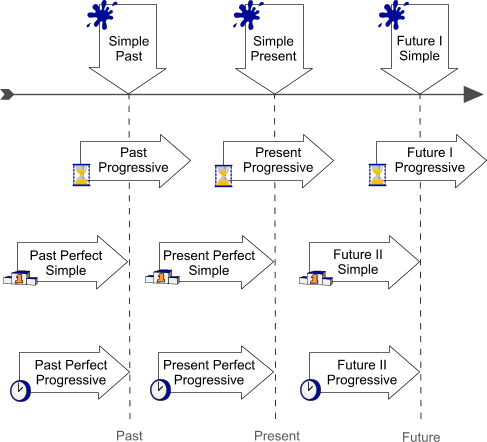
Legend
 moment in time |
|
 period of time |
|
 Result |
|
 Course / Duration |
|
5 maneiras de identificar se uma escola é realmente bilíngue

Atualmente, na área da Educação, a expressão educação bilíngue está em alta e, infelizmente, muitas escolas utilizam o termo inadequadamente por desconhecimento ou tática de marketing, afinal, qual é o pai que não gostaria de ter um filho fluente em dois idiomas?
Entretanto, não basta uma escola intitular-se bilíngue para, de fato, ser. Como atualmente não existe uma legislação específica que determine se uma escola é bilíngue, é importante que pais estejam cientes sobre como identificar se a escola se enquadra na definição.
1- Não basta escolas aumentarem a carga horária.
O ensino bilíngue consiste no ensino EM um segundo idioma e não DE um idioma, em diferentes graus de imersão. Ou seja, não basta a escola ter aulas de inglês todos os dias da semana para considerar-se bilíngue.
2- Não há tradução em educação bilíngue.
Quem faz tradução são cursos de idioma ou aulas de idiomas dentro de uma escola tradicional. Se seu filho demonstrar sempre que aprendeu que apple é maçã, que car é carro e que tree é árvore, pode tratar-se de um sinal de alerta. Em uma aula bilíngue, mesmo que as crianças que estejam em processo inicial de aprendizado perguntem à professora ou professor “mas o que é apple?”, o professor nunca responderá “maçã”. Ele poderá mostrar uma maçã e dizer: “This is an apple!” ou então “Apple is a delicious red fruit every child loves!”
3- A formação dos professores é diferenciada.
Outros fatores que os pais devem analisar são o currículo e a experiência dos professores. Em qualquer profissão isso é importante, mas escolas bilíngues sérias, além de recrutarem profissionais capacitados e experientes, investem na carreira de seus funcionários, com cursos de especialização, palestras e participação em convenções para atualização e aprimoramento no nível do ensino.
Professores bilíngues geralmente têm vivência no exterior, podem ou não ser nativos, mas são profissionais atualizados, que possuem não somente fluência no idioma, mas amplo conhecimento nas características sócio-culturais do país origem do idioma, conforme já mencionei aqui.
4- Não somente aulas são em Inglês, mas o ambiente como um todo.
Os melhores resultados na educação bilíngue são vistos quando instituições transformam a escola em um ambiente bilíngue, ou seja, não importa qual o nível de imersão utilizado, perguntas e respostas entre alunos e professores são feitas em inglês.
Inclusive quando professores conversam com pais, geralmente eles perguntam se os pais falam inglês e, caso a resposta seja positiva, as conversas também são em inglês.
Apesar de não ser uma regra, quando a própria equipe conversa em inglês entre si – e não somente na frente dos alunos – o processo de aprendizado é melhorado e o nível da qualidade do inglês dos professores aumenta. A regra é simples: quanto maior a utilização do idioma, melhor será sua qualidade.
5- Escolas são transparentes e não escondem seus métodos.
Geralmente as escolas genuinamente bilíngues oferecem um tour aos pais para averiguarem os itens citados acima, desta forma, em uma visita pela instituição é possível ver como as crianças conversam entre si, como funcionários conversam entre si e se os professores utilizam um nível mínimo de imersão.
Caso esta iniciativa não parta da escola, cabe aos pais solicitarem esta visita de observação e também buscar referências externas, como avaliações na Internet, opiniões de outros pais que tenham alunos na escola e conversas com crianças que estudem há alguns anos na escola. Crianças com um ou dois anos de estudo em escola bilíngue, mesmo que tenham apenas três anos de idade, já despertam espanto em adultos pela fluência com que falam neste segundo idioma.
Afinal, nenhuma propaganda fala mais alto que uma criança bilíngue.
Texto adaptado da Autora: Letícia Pimentel
18 Behaviors of Emotionally Intelligent People
Emotional intelligence is a huge driver of success. It is the “something” in each of us that is a bit intangible. It affects how we manage behavior, navigate social complexities, and make personal decisions to achieve positive results.
1. You have a robust emotional vocabulary
All people experience emotions, but it is a select few who can accurately identify them as they occur. Our research shows that only 36 percent of people can do this, which is problematic because unlabeled emotions often go misunderstood, which leads to irrational choices and counterproductive actions.
2. You’re curious about people
It doesn’t matter if they’re introverted or extroverted, emotionally intelligent people are curious about everyone around them. This curiosity is the product of empathy, one of the most significant gateways to a high EQ. The more you care about other people and what they’re going through, the more curiosity you’re going to have about them.
3. You embrace change
Emotionally intelligent people are flexible and are constantly adapting. They know that fear of change is paralyzing and a major threat to their success and happiness. They look for change that is lurking just around the corner, and they form a plan of action should these changes occur.
4. You know your strengths and weaknesses
Emotionally intelligent people don’t just understand emotions; they know what they’re good at and what they’re terrible at. They also know who pushes their buttons and the environments (both situations and people) that enable them to succeed. Having a high EQ means you know your strengths and how to lean into and use them to your full advantage while keeping your weaknesses from holding you back.
5. You’re a good judge of character
Much of emotional intelligence comes down to social awareness; the ability to read other people, know what they’re about, and understand what they’re going through. Over time, this skill makes you an exceptional judge of character. People are no mystery to you. You know what they’re all about and understand their motivations, even those that lie hidden beneath the surface.
6. You are difficult to offend
If you have a firm grasp of who you are, it’s difficult for someone to say or do something that gets your goat. Emotionally intelligent people are self-confident and open-minded, which creates a pretty thick skin. You may even poke fun at yourself or let other people make jokes about you because you are able to mentally draw the line between humor and degradation.
7. You know how to say no (to yourself and others)
Emotional intelligence means knowing how to exert self-control. You delay gratification and avoid impulsive action. Research conducted at the University of California, San Francisco, shows that the more difficulty that you have saying no, the more likely you are to experience stress, burnout, and even depression. Saying no is a major self-control challenge for many people, but “No” is a powerful word that you should unafraid to wield. When it’s time to say no, emotionally intelligent people avoid phrases such as “I don’t think I can” or “I’m not certain.” Saying no to a new commitment honors your existing commitments and gives you the opportunity to successfully fulfill them.
8. You let go of mistakes
Emotionally intelligent people distance themselves from their mistakes, but do so without forgetting them. By keeping their mistakes at a safe distance, yet still handy enough to refer to, they are able to adapt and adjust for future success. It takes refined self-awareness to walk this tightrope between dwelling and remembering. Dwelling too long on your mistakes makes you anxious and gun shy, while forgetting about them completely makes you bound to repeat them. The key to balance lies in your ability to transform failures into nuggets of improvement. This creates the tendency to get right back up every time you fall down.
9. You give and expect nothing in return
When someone gives you something spontaneously, without expecting anything in return, this leaves a powerful impression. For example, you might have an interesting conversation with someone about a book, and when you see them again a month later, you show up with the book in hand. Emotionally intelligent people build strong relationships because they are constantly thinking about others.
10. You don’t hold grudges
The negative emotions that come with holding onto a grudge are actually a stress response. Just thinking about the event sends your body into fight-or-flight mode, a survival mechanism that forces you to stand up and fight or run for the hills when faced with a threat. When the threat is imminent, this reaction is essential to your survival, but when the threat is ancient history, holding onto that stress wreaks havoc on your body and can have devastating health consequences over time. In fact, researchers at Emory University have shown that holding onto stress contributes to high blood pressure and heart disease. Holding onto a grudge means you’re holding onto stress, and emotionally intelligent people know to avoid this at all costs. Letting go of a grudge not only makes you feel better now but can also improve your health.
11. You neutralize toxic people
Dealing with difficult people is frustrating and exhausting for most. But high-EQ individuals control their interactions with toxic people by keeping their feelings in check. When they need to confront a toxic person, they approach the situation rationally. They identify their own emotions and don’t allow anger or frustration to fuel the chaos. They also consider the difficult person’s standpoint and are able to find solutions and common ground. Even when things completely derail, emotionally intelligent people are able to take the toxic person with a grain of salt to avoid letting him or her bring them down.
12. You don’t seek perfection
Emotionally intelligent people won’t set perfection as their target because they know that it doesn’t exist. Human beings, by our very nature, are fallible. When perfection is your goal, you’re always left with a nagging sense of failure that makes you want to give up or reduce your effort. You end up spending time lamenting what you failed to accomplish and should have done differently instead of moving forward, excited about what you’ve achieved and what you will accomplish in the future.
13. You appreciate what you have
Taking time to contemplate what you’re grateful for isn’t merely the right thing to do; it also improves your mood by reducing the stress hormone cortisol (in some cases by 23 percent). Research conducted at the University of California, Davis, found that people who work daily to cultivate an attitude of gratitude experience improved mood, energy, and physical well-being. It’s likely that lower levels of cortisol play a major role in this.
14. You disconnect
Taking regular time off the grid is a sign of a high EQ because it helps you to keep your stress under control and to live in the moment. When you make yourself available to your work 24/7, you expose yourself to a constant barrage of stressors. Forcing yourself offline and even–gulp!–turning off your phone gives your body and mind a break. Studies have shown that something as simple as an email break can lower stress levels. Technology enables constant communication and the expectation that you should be available 24/7. It is extremely difficult to enjoy a stress-free moment outside of work when an email with the power to bring your thinking (read: stressing) back to work can drop onto your phone at any moment.
15. You limit your caffeine intake
Drinking excessive amounts of caffeine triggers the release of adrenaline, which is the primary source of a fight-or-flight response. The fight-or-flight mechanism sidesteps rational thinking in favor of a faster response to ensure survival. This is great when a bear is chasing you, but not so great when you’re responding to a curt email. When caffeine puts your brain and body into this hyper-aroused state of stress, your emotions overrun your behavior. Caffeine’s long half-life ensures you stay this way as it takes its sweet time working its way out of your body. High-EQ individuals know that caffeine is trouble, and they don’t let it get the better of them.
16. You get enough sleep
It’s difficult to overstate the importance of sleep to increasing your emotional intelligence and managing your stress levels. When you sleep, your brain literally recharges, shuffling through the day’s memories and storing or discarding them (which causes dreams) so that you wake up alert and clearheaded. High-EQ individuals know that their self-control, attention, and memory are all reduced when they don’t get enough–or the right kind–of sleep. So, they make sleep a top priority.
17. You stop negative self-talk in its tracks
The more you ruminate on negative thoughts, the more power you give them. Most of our negative thoughts are just that–thoughts, not facts. When it feels like something always or never happens, this is just your brain’s natural tendency to perceive threats (inflating the frequency or severity of an event). Emotionally intelligent people separate their thoughts from the facts in order to escape the cycle of negativity and move toward a positive, new outlook.
18. You won’t let anyone limit your joy
When your sense of pleasure and satisfaction are derived from the opinions of other people, you are no longer the master of your own happiness. When emotionally intelligent people feel good about something they’ve done, they won’t let anyone’s opinions or snide remarks take that away from them. While it’s impossible to turn off your reactions to what others think, you don’t have to compare yourself to others, and you can always take people’s opinions with a grain of salt. That way, no matter what other people are thinking or doing, your self-worth comes from within.
Time magazine – Feb. 16
Hamlet character and plot summary


Today there is another one of Shakespeare´s most famous play, Hamlet.
There have been more than fifty film versions of Hamlet since 1900. A few of the most famous are:
Hamlet (1948)
This version was directed by and starred the famous English actor, Sir Laurence Olivier and was the first British film to win an Oscar. Olivier adapted the play and reduced its length to about two hours.
Hamlet (1990)
Director Franco Zeffirelli made the decision to cast Mel Gibson, better known for his roles in action films like Mad Max and Lethal Weapon, as Hamlet. Again, the film adapted the play to make it an acceptable length for cinema.
Hamlet (1996)
Actor/director Kenneth Branagh assembled an all-star cast for thisunabridged version of the play. The film is often mentioned as one of the best Shakespeare film versions ever made.
As well as filmed versions of the play, there have been several films based on the story of Hamlet.
The Bad Sleep Well (Warui yatsu hodo yoku nemuru) (1960)
Famous Japanese director Akira Kurosawa directed this story of a young man joining a powerful company to try to expose the men responsible for the death of his father.
The Lion King (1994)
The king is murdered by his brother. The king’s ghost tells his son to challenge the wicked uncle. Does this sound familiar? Of course this Disney version does not have Hamlet’s tragic ending.
Watch the video
Here is a link to watch the video with subtitles about the story
https://view.vzaar.com/5655672/download
THE MAIN CHARACTERS
Hamlet, Prince of Denmark
Hamlet discovers that his father, the old King of Denmark, was murdered by his uncle, Claudius. Hamlet plans to kill Claudius in revenge, which he does at the end of the play. But Hamlet is wounded in the fight, and dies as well.
Claudius
Claudius murders his brother, the old king of Denmark, by putting poison in his ear. Claudius marries his dead brother’s wife, the queen. Claudius becomes king of Denmark himself. But Hamlet, Claudius’s nephew, finds out what he has done, and kills him.
Hamlet’s mother
Hamlet’s mother, the queen of Denmark, marries her brother-in-law, Claudius. She does not realise that Claudius murdered her husband. She dies by drinking poisoned wine.
Ophelia
Ophelia is Hamlet’s girlfriend. But Hamlet rejects her, and she kills herself.
Polonius
Polonius is King Claudius’s adviser, and is asked to spy on Hamlet. Hamlet kills him by accident.
Laertes
Laertes is Ophelia’s brother. He blames Hamlet for Ophelia’s suicide. At the end of the play, he fights and kills Hamlet. But he is wounded in the fight, and also dies.
© British Council
I hope you have enjoyed learning about it.
Thank you.
Shakespeare invented new words

Nobody knows exactly how many words in the English we use everyday were invented by Shakespeare.
Some people have claimed that Shakespeare invented many thousands of words but a more generally accepted figure is 1,700.
As this National Geographic article explains, Shakespeare may have been the first person to use some words in writing or to popularise their use. Whether he ‘invented’ the words or not, he has certainly had a profound effect on English vocabulary.
Here are some of the words and phrases usually attributed to Shakespeare..
- bedroom
- blanket
- fashionable
- freezing
- gossip
- hostile
- ladybird
- lonely
- manager
- obscene
- priceless
- puke
- undress
- unreal
- watchdog
- pomp and circumstance
- the be-all and end-all
- flesh and blood
An internet search for ‘words invented by Shakespeare’ will bring up many thousands of results. Do a search and see which other words you can find to add to the list.
Watch this video: https://www.futurelearn.com/courses/explore-english-shakespeare/1/steps/59163?utm_campaign=Share+Links&utm_medium=futurelearn-open_step&utm_source=google-plus
© British Council
More about Shakespeare
The course has reached the end of another week on Exploring English: Shakespeare online course. But don’t worry! There’s still plenty of time to join! Watch this video review of Week 3 on Macbeth and check out the extra resources!
If you’d like to join the free course, just click here: http://bit.ly/LEShakespeare
#FLShakespeareEE #ShakespeareLives #MOOC
Facts about Shakepeare’s life

Shakespeare was born in Stratford-upon-Avon in London. However, much about his life remains uncertain or mysterious. There are even some people who think he didn’t write the plays!
Here are some of the things we do know about Shakespeare:
- Shakespeare was born and died on the same day, 23 April.
- When Shakespeare got married, he was 18. His wife was 26 – and pregnant.
- One of Shakespeare’s relatives was arrested for plotting against Queen Elizabeth I, and was executed.
- Shakespeare acted in his own plays. For example, in Hamlet, he played the ghost of Hamlet’s father.
- Shakespeare performed as an actor in front of Queen Elizabeth I, and after her death in 1603, in front of King James I.
- The Globe Theatre in London burned down in 1613, when a large gun set fire to the roof during a performance of Shakespeare’s play Henry VIII. It was rebuilt.
- Shakespeare spelled his own name in several different ways, including ‘Shakspere’ and ‘Shakspeare’.
- It is known that Shakespeare wrote at least 38 plays. It is possible that he also wrote others which have been lost.
- Anagrams of the name William Shakespeare include ‘I am a weakish speller’ and ‘I’ll make a wise phrase’.
- According to the Shakespeare Birthplace Trust, Shakespeare introduced nearly 1,000 new words to the English language.
The Universal Declaration of Human Rights
Read these five clauses from the Declaration of Human Rights.
Which one do you think is the most important?
Do we have them in our country?
- The Right to Equality. We are all born free. We all have our own thoughts and ideas. We should all be treated in the same way.
- The Right to Trial. If we are put on trial this should be in public. The people who try us should not let anyone tell them what to do.
- The Right to Marriage and Family. Every grown-up has the right to marry and have a family if they want to. Men and women have the same rights when they are married, and when they are separated.
- The Right to Freedom of Thought. We all have the right to believe in what we want to believe, to have a religion, or to change it if we want.
- The Right to Education. Education is a right. Primary school should be free. We should learn about the United Nations and how to get on with others. Our parents can choose what we learn.
© British Council

