Ano Novo Chinês – Ano do Cavalo


Dia 31 será o Ano Novo Chinês. Você sabe qual é o seu signo no horóscopo chinês? O que ele representa? Qual sua sorte para 2014?chinese_new_year_2014_clipart

Origin

The Chinese Zodiac, known as Sheng Xiao, is based on a twelve year cycle, each year in that cycle related to an animal sign. These animal signs are the rat, ox, tiger, rabbit, dragon, snake, horse, sheep, monkey, rooster, dog and pig. It is calculated according to Chinese lunar calendar . Ancient people observe that there are 12 full moons within one year. So, its origin is associated with astronomy. Each animal sign is usually related with an earthly branch, so the animal years were called zi rabbit, chou ox, yin tiger, mao rabbit, chen dragon, si snack, wu horse, wei sheep, shen monkey, you rooster, xu dog and hai pig.

12 Animal Signs

For a long time there has been a special relationship between humans and the 12 zodiacal animals. It is believed that the years represented by the animals affect the characters of people in the same manner as the sign of zodiac adopted by western civilizations. People under different animal signs have distinct characters. Some signs are perfect match while some are less compatible or even born opponents.

Check the link below to discover about you and your perfect match.

Good Luck!

http://www.travelchinaguide.com/intro/social_customs/zodiac/

The Lantern Festival

In China, the New Year is a time of family reunion. Family members gather at each other’s homes for visits and shared meals, most significantly a feast on New Year’s Eve.

The lantern festival is held on the fifteenth day of the first lunar month. Some of the lanterns may be works of art, painted with birds, animals, flowers, zodiac signs, and scenes from legend and history. People hang glowing lanterns in temples, and carry lanterns to an evening parade under the light of the full moon.

In many areas the highlight of the lantern festival is the dragon dance. The dragon—which might stretch a hundred feet long—is typically made of silk, paper, and bamboo. Traditionally the dragon is held aloft by young men who dance as they guide the colorful beast through the streets.
Read more:  Chinese New Year: 2014 | Infoplease.com http://www.infoplease.com/spot/chinesenewyear1.html#ixzz2rVkHfk3N

Novo Domínio

cropped-anuncio-paula-lyra-elt-school.jpgPrezados Alunos, Pais e Amigos,

Acabei de adquirir o domínio do meu blog que passará a ser:

https://paulalyra.com sem o wordpress.

Espero que esta aquisição facilite e incentive ainda mais nosso contato.

Abraços  e muito obrigada a todos que confiam e acreditam em meu trabalho.


Como melhorar sua conversação em Inglês


Why is conversation difficult for some English learners?

The lack of vocabulary leads to some students ‘blocking’. They slow down or stop speaking completely because of a lack of self-confidence or of appropriate vocabulary.

How to Improve Conversation Skills

Now that we understand the problem, the next step is to improve the situation. Here are some tips to improve small talk skills. Of course, making effective small talk means lots of practice, but keeping these tips in mind should improve overall conversational skills.

Do some research

Spend time on the Internet, reading magazines, or watching TV specials about the type of people you are going to meet. For example: If you are taking a class with students from other countries, take time after the first few days of class to do some research. They will appreciate your interest and your conversations will be much more interesting.

Stay away from religion or political beliefs

While you may believe in something very strongly, beginning conversations and making small talk about your own personal convictions may abruptly end the conversation. Keep it light, don’t try to convince the other person that you have the ‘correct’ information about a higher being, political system or other belief system.

Use the Internet to gain specific vocabulary

This is related to doing research about other people. If you have a business meeting, or are meeting  people who share a common interest (a basketball team, a tour group interested in art, etc.), take advantage of the Internet to learn specific vocabulary. Almost all businesses and interest groups have glossaries on the Internet explaining the most important jargon related to their business or activity.

Ask yourself about your culture

Take time to make a list of common interests that are discussed when making small talk in your own culture. You can do this in your own language, but check to make sure that you have the English vocabulary to make small talk about those subjects.

Find common interests

Once you have a subject that interests both of you, keep to it! You can do this in a number of ways: talking about travel, talking about the school or friend you have in common, talking about the differences between your culture and the new culture (just be careful to make comparisons and not judgments, i.e.,  The food in our country is better than the food here in Brazil”).

Listen

This is very important. Don’t get so worried about being able to communicate that you don’t listen. Listening carefully will help you understand and encourage those speaking to you. You might be nervous, but letting others state their opinions will improve the quality of the discussion – and give you time to think of an answer!

More info: http://esl.about.com/od/speakingenglish/a/smalltalk.htm?nl=1

Como fazer um “Business Report”

Business Meeting Business reports provide important information for management that is timely and factual. English learners writing business reports  need to make sure that the language is precise and concise. The writing style used for business reports should present information without strong opinions, but rather as direct and accurately as possible. Linking language should be used to connect ideas and sections of the business report. This example business report presents the four essentials that every business report should include:

  • Terms of Reference
  • Procedure
  • Findings
  • Recommendations

Reports: Example Report

Terms of Reference

Margaret Anderson, Director of Personnel has requested this report on employee benefits satisfaction. The report was to be submitted to her by 28 June.

Procedure

A representative selection of 15% of all employees were interviewed in the period between April 1st and April 15th concerning:

  1. Overall satisfaction with our current benefits package
  2. Problems encountered when dealing with the personnel department
  3. Suggestions for the improvement of communication policies
  4. Problems encountered when dealing with our HMO

Findings

  1. Employees were generally satisfied with the current benefits package.
  2. Some problems were encountered when requesting vacation due to what is perceived as long approval waiting periods.
  3. Older employees repeatedly had problems with HMO prescription drugs procedures.
  4. Employees between the ages of 22 and 30 report few problems with HMO.
  5. Most employees complain about the lack of dental insurance in our benefits package.
  6. The most common suggestion for improvement was for the ability to process benefits requests online.

Conclusions

  1. Older employees, those over 50, are having serious problems with our HMO’s ability to provide prescription drugs.
  2. Our benefits request system needs to be revised as most complaints concerning in-house processing.
  3. Improvements need to take place in personnel department response time.
  4. Information technology improvements should be considered as employees become more technologically savvy.

Recommendations

  1. Meet with HMO representatives to discuss the serious nature of complaints concerning prescription drug benefits for older employees.
  2. Give priority to vacation request response time as employees need faster approval in order to be able to plan their vacations.
  3. Take no special actions for the benefits package of younger employees.
  4. Discuss the possibility of adding an online benefits requests system to our company Intranet.

Important Points to Remember

  • A report is divided into four areas:
    • Terms of Reference– This section gives background information on the reason for the report. It usually includes the person requesting the report.
    • Procedure– The procedure provides the exact steps taken and methods used for the report.
    • Findings– The findings point out discoveries made during the course of the report investigation.
    • Conclusions– The conclusions provide logical conclusions based on the findings.
    • Recommendations– The recommendations state actions that the writer of the report feels need to be taken based on the findings and conclusions.
    • Reports should be concise and factual. Opinions are given in the “conclusions” section. However, these opinions should be based on facts presented in the “findings”.
      • Use simple tenses (usually the present simple) to express facts.
      • Use the imperative form (Discuss the possibility …, Give priority …, etc.) in the “recommendations” section as these apply to the company as a whole.

More info check the link: http://esl.about.com/od/businessenglishwriting/a/bizdocs.htm?nl=1

Como ajudar seus filhos a não brigarem por causa de brinquedos

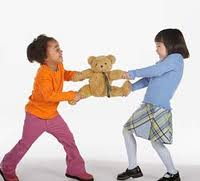
Brigas por disputar brinquedos é comum entre crianças, como ensiná-los e se comunicar e evitar brigas é muito importante.

Toy Fight

“Use your words.”

by: http://notjustcute.com/2014/01/13/nine-words-to-end-fights-over-toys/

It’s a popular phrase adults say when kids are acting out.  And kids do need to learn how to effectively communicate verbally in order to move away from communicating behaviorally.  But in order to use their words, they have to have the words.

We have to be intentional in teaching our children the social scripts they need to navigate the social tides of life.  By teaching kids a few simple phrases, they quickly recognize them as you coach them through regular opportunities for problem solving, and soon they feel comfortable enough with them to use them independently.

If I had to pick one phrase that I have seen make the most difference for kids in social situations, it would be these nine words:

“Can I have a turn when you’re done please?”

Sharing and turn taking are things we value as adults, but they are extremely vague concept for kids.  Most of the time, kids really only understand how they work when it comes to making sure they get their turns!  Through their developmental lens, many preschoolers adhere to the philosophy that “What’s your is mine and what’s mine is mine.”  This is why “He’s not sharing!” or “She took my toy!”  is such a frequent complaint at preschools and play dates.

Often, our response is to force sharing.  (Or at least the appearance of sharing!)  We set timers or pry something from their clenched little fists, in an effort to restore order.  But, this approach robs kids of critical problem solving practice and opportunities to develop their own social skills.  We may value peace and order as adults, but kids need a manageable amount of conflict and chaos to give them meaningful social skill practice.

Given their own tools and scripts as well as adequate opportunities to practice, kids will not only gain the skills they need to be socially competent, but they’ll also increase their confidence in their own ability to solve their own problems.  We communicate several key points that ease the process for both kids involved.

1.  I want a turn.  This empowers the child who is asking.  It helps the child to know it’s OK to communicate your needs and wants to others, and that you can and should do that clearly and politely.

2.  You get to finish.  The magic ingredient in this phrase is “when you’re done”.  It communicates to the child in possession of the object that no one is trying to take it away or force them to “share”.  It lets them feel a sense of control, which almost always has the result of softening the child’s white knuckled grip.

Without these three extra words, children only hear that they are losing something– that someone is taking something away from them.  With those three words, consideration is given to the child with the object.  Instead of losing an object, they are gaining an element of control.

I have watched time and again as two children have fought passionately over an object, then had an intervening adult introduce this nine word phrase.  More times than not the child who is in possession of the object is done within a matter of minutes (or even seconds!) — but only when they get to do it on their terms.

The fight wasn’t about who had the object as much as it was about who had the power.

What about when the child doesn’t hand it over so quickly?

Sometimes you can coach children through this phrase and simply follow up with, “So Ben, when you’re done, find Sky and make sure she gets the next turn, OK?” and that is that.  The two seamlessly make the switch-a-roo on their own moments later.

Sometimes you coach them through the dialogue and the child in possession says, “I’ll never be done!”

There are a few things you could do here, depending on the situation and the temperaments of the kids involved.  You can keep things light and simply say, “Well, there are so many fun things to do here, I doubt you’ll want to play with that  F O R E V E R!  So when you decide you’re done, just make sure you give it to Sky so that she can be next.”  For other kids you might need to say, “Well, I know some kids like to use timers to decide when their turns are over.  Do you two want to try that?  Ben, how much more time do you think you need?”  If the two agree on a reasonable number, great!  Help the children set a timer, and give it to one of them, so that they can be in charge.   If they don’t come up with a reasonable number (“14 hours!”), you may have to give a few suggestions and let them choose from those.

Poems and Finger Plays


Tratam-se de rimas ou cantigas repetitivas. São muito populares entre as crianças e ajudam às crianças a fixarem conteúdos relativos à numerais, lugares, partes do corpo ou vocabulário básico em Inglês. Aproveite a chance e aprenda também.


Five Little Monkeys bedFive Little Monkeys on the bed

“Five Little Monkeys jumping on the bed

One fell off and bumped his head

Mama called the doctor and he said

No more monkeys jumping on the bed! “

Four Little monkeys………… Three……….Two………One

No more monkeys jumping on the bed,

Now it is Mama`s turn to jump on the bed! ”


 Five Little Monkeys TreeFive Little Monkeys in a tree

“Five Little Monkeys sitting in a tree

Along comes Mr. Crocodile,

Can´t catch me, can´t catch me,

Snap!

On no, where is he?

Four Little monkeys …… Three………Two………One

No more monkeys sitting on a tree,

And Mr. Crocodile is as fat as he can be! “


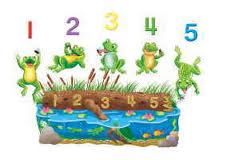
 Little frogsFive little speckled frogs

“ Five little speckled frogs
Sat on a speckled log
Eating some most delicious grubs – yum, yum
One jumped into the pool
Where it was nice and cool
Now there are four green speckled frogs – glub, glub.
Four little speckled frogs ………….. Three……….Two………
One little speckled frogs
Sat on a speckled log
Eating some most delicious grubs – yum, yum
One jumped into the pool
Where it was nice and cool
Now there are no green speckled frogs – glub, glub.”

Video and song  http://youtu.be/0YkXfolDaDs


Ducks Five Little Ducks

“ Five little ducks went out to play

Over the hills and far away

Mama duck called quack, quack, quack quack

But only four ducks came back.

Four little ducks …………Three……….Two………

One little ducks went out to play

Over the hills and far away

Mama duck called quack, quack, quack quack

And all her five little ducks came back! “

Video and Lyrics: http://www.youtube.com/watch?v=mFGAI7T-Ca8


Bees Here is the beehive where are the Bee’s?

Here is the beehive
But where are the bees?
Hidden away where nobody sees.
Look and you’ll see them
Come out of the hive,
One, Two, Three, Four, Five.
Bzzzzzzzzzzzzz

Video: http://www.youtube.com/watch?v=INoZvI0STRg

http://www.youtube.com/watch?v=frjohL7G6NY


Tommy Thumb Where are you!

Video: http://www.youtube.com/watch?v=ypve0HIuJeM

Tommy Thumbs up!

http://youtu.be/H5gg1xDwxtE

Ten Little Fingers on my hand

http://www.youtube.com/watch?v=TFAyQJKGJRA

Videos bacanas sobre Letras do Alfabeto

Assistam à esses vídeos sobre as letras do alfabeto com seus filhos. São simples e têm boas informações.

Ao fundo do cenário, durante o decorrer do alfabeto, as diferentes estações do ano vão acontecendo e a personagem vai se adaptando a elas.

Depois continuarei postando outras letras e vídeos. ” Enjoy!”

Ms Paula

Ms Paula


Letra A –  http://www.youtube.com/watch?v=nWtDhk2BD3o

Letra B –  http://www.youtube.com/watch?v=qnDqXsvr1JI

Letra C – http://www.youtube.com/watch?v=r3thhq44eXE

Letra D – http://www.youtube.com/watch?v=2YbVRVyrZhU


“Conversa de Macho” em Inglês

Vc sabe o que significam essas gírias?

belly laugh = to laugh hard from your abdomen

conk out = to go to sleep

dude = idiomatic / slang greeting used when addressing someone

feel no pain = to have consumed a lot of alcohol or other drug and feeling very good 

hang five = to spend time relaxing

kick in the pants = a lot of fun

mellow out = to calm down relax

name your poison = to choose which type of drink / substance you would like

one for the road = a drink before leaving

party animal = someone who likes to consume a lot of alcohol or drugs

shoot the breeze = to speak, have a relaxed conversation

speak of the devil = phrase used when someone appears shortly after s/he is mentioned

twiddle one’s thumbs = to waste time

veg out = to relax by doing nothing in particular watching TV or some other easy activity

wing it = to improvise do something by intuition rather than following a set plan

Leia esse diálogo entre 3 amigos em um bar e aprenda algumas da slangs (gírias) usadas em conversas entre homens.

Tom: Dude! I haven’t seen you for ages! How are you doing?

Andy: I’m doing great. It’s good to see you again. What have you been up to lately?

Tom: Nothing much. You know, the job, the wife, the kids, the dog, lots of responsibility. Still, it’s a good life I lead. Nothing to complain about.

Andy: I’m glad to hear it. Have you seen Peter lately?

Tom: Speak of the devil! Here he comes now!

Andy: No, you’re kidding … You’re right. There he is! Well, this is my lucky day. First I see my roommate from college, and then here comes our favorite drinking buddy.

Tom: Yeah, Peter’s quite the party animal. Seems like the gods are trying to tell us something. I think we need to hang five together.

Peter: Hey dudes! What’s up? Long time no see!

Andy: You can say that again. What have you been doing lately?

Peter: Oh you know, twiddling my thumbs. I haven’t really done much of anything for the last few weeks.

Tom: That can’t be true. You were always a kick in the pants. I can’t imagine you’ve been domesticated.

Peter: No, no, I’m still single. I’m just mellowing out in my old age.

Andy: Ha! That doesn’t sound like you. Hey, let’s go to a bar.

Peter, Tom: Sounds like a good idea…

(three hours later somewhere in a bar)

Tom: Dudes, I have to get going. I need to conk out. Tomorrow’s another day.

Andy: Why would you want to leave now?! We’re feeling no pain!

Tom: Right, but tomorrow I’ll be feeling plenty of pain right between the eyes!

Andy: (lets out a belly laugh) Come on, just hang around and shoot the breeze.

Peter: Yeah, at least one more for the road.

Tom: OK, OK, you’ve convinced me.

Andy: Name your poison.

Tom: I’ll have a whisky sour.

Peter: Make that two, bartender.

Tom: So Peter, what about your presentation tomorrow?

Peter: Oh that, yeah. I guess I’ll have to wing it. I’m not going to get any work done tonight.

Tom: That’s our party animal.

Andy: Party on, dudes!


Usando play dough (massa de modelar) de forma criativa

Devemos sempre desenvolver nas crianças suas habilidades, múltiplas inteligências e criatividade. Brincando é que conseguimos os melhores resultados.

Veja algumas ideias em Inglês de como ensinar formas geométricas utilizando massa de modelar.

playdough

Circle “Make a circle. Pretend it’s a cookie and add some chocolate chips.” Children can pinch off some play dough and roll it into tiny chocolate chips to decorate their cookie.

Triangle: “Pretend it’s a pizza and add some pepperoni.” Children can form little pepperoni out of extra play dough to make the triangle look like a slice of pizza.

Square: “Pretend it’s a window and add some flowers or trees outside.” Children can use play dough to make either some flowers to place outside the window or some trees.

Rectangle: “Pretend it’s a table and put some food on it. Make some animals in a cage.”

Diamond/Rhombus: “Pretend it’s a kite and add a kite tail.” Children can roll out some more dough to make a kite string.

Oval: “Pretend it´s Easter. Let´s make some Easter Eggs!”

Free: “Pretend there is a racetrack and add some cars.” Cars might not be easy to make with play dough, but show children how to make a very simple representation of a car with play dough (no details).

Mais ideias: http://www.prekinders.com/shape-play-dough-mats/

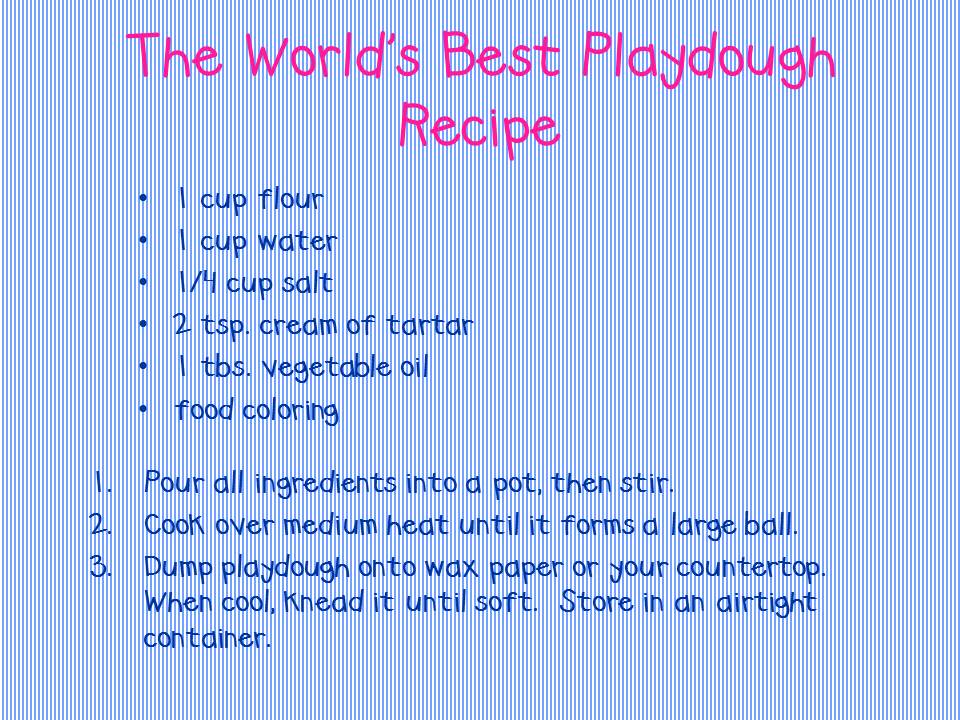
Muitas outras atividades podem ser desenvolvidas utilizando-se play dough e os alunos amam. Segue uma receita caseira para fazer a massa. Mãos à massa e boa atividade!

Play Dough recipe for kids