A Importância do Homework para alunos de Inglês

Keep calm and do homework

Muitos dos meus alunos detestam fazer homework (dever de casa), alguns então nem online. Desta forma fica muito difícil fixar o conteúdo aprendido em classe de 2 horas semanais.

Portanto, aqui segue um link em Inglês que destaca 6 razões para se fazer o homework.
http://www.teachthemenglish.com/2013/12/the-case-for-6-reasons-why-our-language-learners-should-get-homework/

Homework blackboard

1. Class time isn’t enough and learners need extra practice

Homework should above all else serve to review something that has been learned in class, or to offer further practice of something that was new and particularly tricky. With this in mind, make sure that whatever homework you assign can be completed by learners independently and with relative ease. Homework that gives the student an opportunity to further practice what he or she has just learned in class to further fix the concepts in their mind can be extremely worthwhile. Ideally, it should be something that is useful but that might have been boring had it been done in class (such as a gap fill text).

2. Homework helps them to remember the things they learned in class

Homework can do a great job of reinforcing the content of lessons, and provides a valuable opportunity for extra practice… before they have a chance to forget everything! Basically, homework should always supplement and click that ‘I remember’ button, so don’t assign new material because there’s a big chance that A) they will not understand it, and B) become frustrated with the tasks as well as being less open to discussing the work in class later on. This point is particularly important with classes that you see infrequently, as they have many chances to forget what you did in the last class!

3. Homework nurtures responsibility and facilitates the development of good study habits

At its best, homework helps to create an awareness of the methods of study fundamental to success in learning a language. Homework that bears this in mind will give learners the valuable experience of working to deadlines while facilitating teacher/learner interaction: once learners have completed such homework, you have to give feedback on their performance and the process as a whole.

4. Homework is a useful tool in preparing learners for tests and getting to grips with other aspects of the curriculum

Bear in mind that not all homework has to be graded, although doing so often encourages learners to actually complete the work, especially when it is geared toward some end goal such as an exam. A good thing to do in such cases is to give homework that follows the specifications of the assessment as closely as possible. What’s more, work done at home can take advantage of the quiet and private conditions needed for committed work.

5. Homework can help students to make more rapid progress in their language acquisition

Homework can provide valuable practice of skills learned in the classroom. We know that we are pushed for time and that each lesson is valuable contact time. We don’t want to be going into too much detail or doing too many tasks on one language point, regardless of whether or not the learners need it. At some point, you need to provide ways for that practice to take place in the learners’ own time, so you can get on with new stuff next lesson!

6. It can allow students to use materials and other sources of information that are not always available in the class room

Some of us have the luxury of computers and projectors in class, others do not. Some exercises that are on the net work best as self study materials anyway. Think about the resource you want learners to use and in particular whether it is more suited to classroom use or for personal study. Furthermore, assigning research tasks that require learners to go out into the wider world and independently find resources that link to what you did in class can be a useful and motivating activity.
Homework

Martin Luther King´s Day

File:Martin Luther King press conference 01269u edit.jpg

January 15th

One holiday we celebrate

Honors a special man,

Who taught us to be fair

To everyone we can.

He said, “Do not fight.”

Solve problems peacefully.

Think about how others feel …

Kindness is the key.

Who is this special man,

Whose name you hear us sing?

Whose holiday we celebrate?

It’s Martin Luther King!

Martin Luther King  was the chief spokesman for nonviolent activism in the civil rights movement, which successfully protested racial discrimination in federal and state law.

The campaign for a federal holiday in King’s honor began soon after his assassination in 1968.

President Ronald Reagan signed the holiday into law in 1983, and it was first observed three years later.

At first, some states resisted observing the holiday as such, giving it alternative names or combining it with other holidays.

It was officially observed in all 50 states for the first time in 2000.

Activity Ideas

WHAT ARE YOUR DREAMS?

Ask your children to name something they would wish for our world. Give  some examples to get children thinking. Next, let each child draw a picture to  show his or her wish.  At the bottom of  each picture, write a few words to explain the child’s wish. Finally, bind the  pictures into a class booklet titled “Our Dreams for Our World.”  Review the booklet with children, then leave in your book corner for  individuals to share.

COMING  TOGETHER

Read to children The Crayon Box That Talked, by Sharon Derolf. Help children  understand that people who are different from one another can, with respect and  understanding, enjoy great friendships together. Then give children spray  bottles filled with different colors of water. Let children spray a bed sheet  and watch as the different colors run together to form a beautiful display. Explain  that although all the colors are different, they blend together nicely, just as  people can.

THE  SAME PLANET

Help children make this simple snack to demonstrate that we all share  the same Earth. Use a round cookie cutter to cut circles of bread. The circles  represent our Earth. Give one circle to each child. Give each child about five  chocolate chips, five white chocolate chips, and five butterscotch chips. The  chips represent the different people that live in our world together. Help  children press their chips into their bread circles and enjoy their “diversity  snacks.”

MAKING  PEACE

While peaceful conflict resolution should be promoted all year long,  this center idea helps drive home the idea of peace when celebrating Martin  Luther King, Jr. Set up a table and chairs in a corner of your classroom. Tell  children this is the peace table. Talk with children about Dr. King’s belief in  solving problems without fighting or name-calling. Reinforce the concept of  working out differences by talking and compromising. Invite children to use the  peace table when they need to settle a problem. Praise children for their  efforts and give each one a precut white dove as a peace certificate. Include  each child’s name and a special sticker on his/her certificate.

4 Formas de entreter seus baixinhos enquanto vc cozinha

Toddlers in the Kitchen

How do they move so fast?


With a curious, busy 18 month old , the idea of actually preparing a meal without suffering serious property damage or charring the meal in the process can be daunting.

But by taking advantage of your toddler’s curiosity, desire for sensory stimulation, growing motor skills, and budding imagination, you can keep your child entertained, engaged, and right by your side while you work in the kitchen.  Here are four simple ideas to get you started:


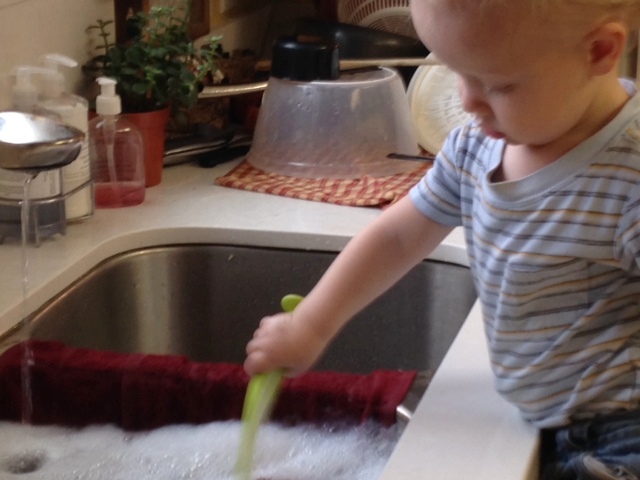
washing

1.  Do the Dishes:

Set your child up with a safe chair or step stool at the kitchen sink.  Add a little soap and water to the basin and give your child a few utensils to play with in the water.  Turn the faucet on to a slow drip to create more interest.  Once you’re done cooking, your sink will be ready for your dishes!  (Tips: Make sure there’s nothing near the sink that shouldn’t end up in it.  We are talking about toddlers here!  Also, I’ve learned by sad, soggy experience that anything that can hold water will be filled and likely dumped out onto the floor.  Measuring spoons, whisks, and spatulas work best here!)

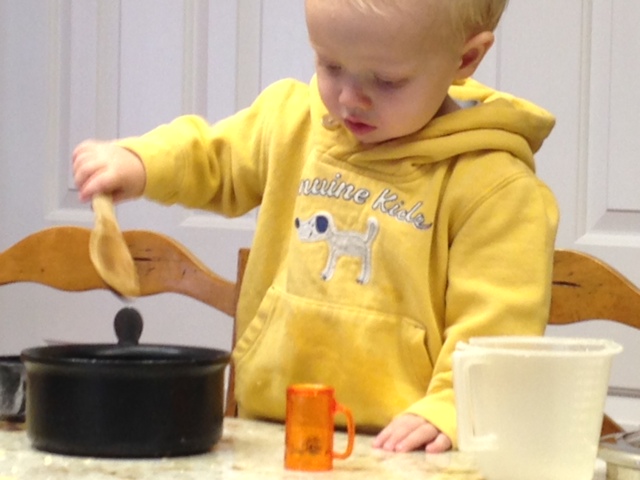
cooking

2.  Get Cookin’:

Let your little one play along.  A small saucepan with a wooden spoon along with a plastic measuring cup for pouring will do the trick.  Sometimes an empty pot will do, other times you may need a little play food, water, dry pasta, or craft pompoms for pouring and stirring.  My little guy has also enjoyed having canned food around to pretend to pour in, or simply to place in the pot whole!

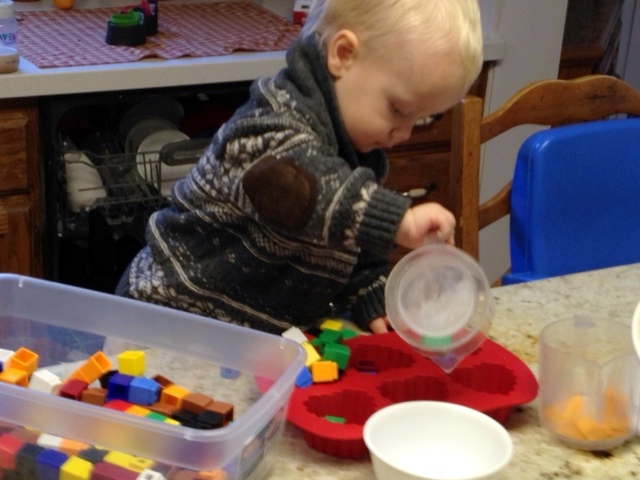
pouring blocks

3.  Pull Out the Pans:

Your kitchen cupboards are full of fascinating containers!  Muffin tins and measuring cups are often toddlers’ favorites!  Add those with loose parts to manipulate and move from one container to the next.  (Note that this, as well as the other activities, assume that you are supervising closely as you work side by side in the kitchen.)  Items that work well for this activity include unifix cubes (above), craft pom poms, small crackers, cereal, or dry pasta.  You could also add in some tongs for another level of fun experimentation.

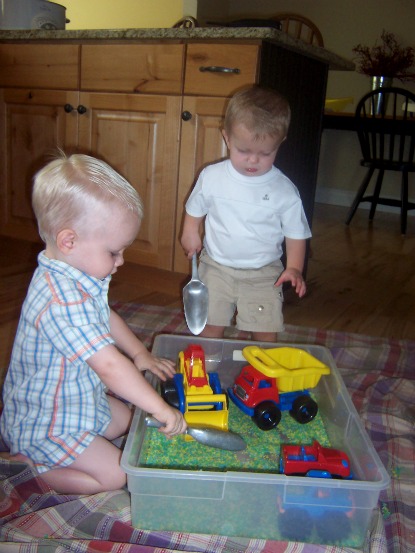
bin

4. Fill Up a Bin:

Keep a flat storage bin and a drop cloth handy for some sensory play in your kitchen.  Using media like colored rice, dry pasta, craft pompoms,  or shredded paper, along with a few scoops, plastic figures, and/or toy cars will keep your child engaged and entertained so long you might start making gourmet meals!  Teach your child boundaries for sensory play by using these tips.  When  you’re done, hopefully the bulk of the mess will be on the drop cloth, and you can simply fold it all together and shake it back into the bin.

What do you do to keep toddlers entertained while you cook?


Activities with Letters V and W

Anuncio Paula Lyra ELT School

Letter U


U can say “uh”

Or U can say “yew.”

Whatever you do,

Be careful with U!

There’s up and there’s under

And unicorn, too.

So whatever you do

Be careful with U!


Letter V

V is quite happy   One sound does it know   There’s van and vanilla,   And yes, video!

Can’t think of V’s sound?   Don’t worry or stop…   Picture a volcano   That just blew its top!


UMBRELLA ART   Cut paper baking cups in half. Give one to each child. Help children glue their half cups onto a sheet of drawing paper. These are “umbrella” tops. Next let students glue a piece of pipe cleaner just under their “umbrellas” for handles. Encourage children to draw rainy day pictures around their umbrellas.

DRAWING UNDERNEATH   Tape a piece of drawing paper on the underside of a table top. Invite children to draw a picture with crayons while sitting or lying on the floor under the table. When pictures are complete, display them with this rhyme: We had such fun drawing     Under the tabletop.     It made us laugh to think     That we were drawing up!

U TOSS IT!   Cut out several large letter U shapes from poster board. Insert a wooden dowel into a coffee can of dirt. Invite children to try to toss the U shapes and get them around the dowel.

VERY COOL VISORS   Purchase foam visors like these from a craft store or online. Invite children to use puffy fabric paint or other fabric paint to decorate and personalize their visors. Then you might invite them to sing this little jingle (sung to tune of “Farmer in the Dell”): A visor shields my eyes,     A visor shields my eyes.     I wear a visor ’cause     I am very wise!

VEGGIE CUT UP   Cut a variety of vegetables into simple shapes. Children can dip the shapes into different colors of paint and create collages of prints. Then serve cut raw vegetables with dip for children to taste.

VOTING FOR VANILLA   Have a vanilla party and set out small portions of vanilla pudding, vanilla milkshake, vanilla wafers, vanilla frosting, and so on. Let children taste the samples and vote for their favorite. Create a “Vanilla Chart” and record children’s votes on it. Finally, ask more-than or less-than questions that the children can answer by using the chart.


Check out the following Web sites for additional background and activities.

Letter U Activity Sheet   Use this for extra writing practice. http://www.teach-nology.com/worksheets/early_childhood/alphabet/u/

Unicorn Coloring Page   Color a unicorn. http://www.first-school.ws/t/alpha3_unicorn_b.htm

Letter V Songs   Feel like singing? You’ll find some fun songs here. http://www.everythingpreschool.com/alphabet/V/songs.htm

Alphabet Coloring  V   Fun coloring for all! http://akidsheart.com/threer/lvl1/vprint.htm

V Activities   Try any one of these. http://www.everythingpreschool.com/alphabet/V/science.htm

We Love Holidays

dscn04171.jpg

Holidays are coming.

How do we know?

We light special candles,

And watch them as they glow.


Holidays are coming.

How do we know?

We smell cookies baking,

Yum! How fast they go!


Holidays are coming.

How do we know?

We feel it getting colder …

Do you think it will snow?

****************************************************************

ACTIVITY IDEAS

WINTER LIGHTS

Read to children Lights of Winter, by Heather Conrad. This book explains many different winter holidays, describing the respective celebrations and teaching their commonality. Discuss which holidays children honor, allowing individuals to describe how they celebrate. Then on an easel pad, create an acrostic poem. Write the word holiday down the left side of the page. Invite children to think of a word that begins with each letter in holiday and helps describe or refer to it. Example: h = happy. Provide assistance as needed.

DREIDEL, DREIDEL

Cut from paper 20 dreidel shapes. On 10 of the shapes, write a numeral from one to 10. On the remaining 10 shapes, show a coordinating number of dots (from one dot to 10 dots). Children may wish to decorate them with crayons, glitter or sequins. Placer all 20 shapes in a math center and invite children to play a matching game.

FIRST FRUITS

Talk with children about the celebration of Kwanzaa. Explain that it is an African American holiday that celebrates the “first fruits of a harvest.” Explain that corn is a staple of that harvest. Invite children to make these simple corn collages. First, print out this template and copy it (one for each child):  http://www.kidsdomain.com/craft/cegif/collage-pat.gif. Cut out each corn/leaf shape and paste it onto a piece of brown construction paper. Invite children to color only the corn leaves green. Next, give each child a handful of unbuttered popcorn and help him/her glue it onto the corn cob portion of the template. Display children’s “first fruits.”

A DIYA FOR DIWALI

Explain that Diwali is a Hindu celebration with symbols of candles and lights. A diya is a clay bowl with a wick dipped in oil that is often burned during Diwali. Invite children to make their own diyas to honor the holiday. Give each child a golf-ball size piece of white air-drying clay. Help children knead the clay until it is pliable. Next, shape the clay into a small bowl that is large enough to hold a tea candle. Let children press sequins, little plastic gems or glitter around the outsides of the bowl, When the bowls are dry, add tea candles and let children take their diyas home to share with their families.

Aulas de intensivo de férias e colônia para seus filhos.